Sunday, September 23, 2012

Hiking in the Swiss Alps


Hiking doesn't get much better than this. Big mountains, breathtaking views and world-class trails -- steep, challenging and a little bit scary -- stretching out for hundreds of kilometres in all directions.

Hiking in the Swiss Alps isn't exactly a wilderness experience. The valleys are dotted with resort towns and railway lines. The mountainsides are home to cows and goats rather than bears and cougars. It's wilderness lite. But this is part of the charm of hiking in Switzerland. Civilization never really disappears but it doesn't encroach on the landscape either. It strikes the right balance between nature and culture. You can hike for hours with nothing but mountain peaks and frozen glaciers for company and then, like a mirage in a desert, you turn a corner and there's a mountain hut serving up cold beer on the edge of a cliff. It's luxurious and I love it.

I've gone soft and I'm okay with that. Ten years ago I would have scoffed at the idea of hiking in a developed area. It's easy to be a backcountry snob in Canada with its open spaces and wild places. Hiking back home means walking into the wilderness with your tent on your back and walking out a week later dirty, smelly and covered in mosquito bites. No hotels, no restaurants, no hot showers, no cold beer. Nothing but uninterrupted wilderness.

The only downside is that it's impossible to get to the edge of civilization in Canada without a car. Not just a car but the kind of car that can withstand bone-rattling logging roads that deliver you to the trailhead. All of the backcountry hiking I did in British Columbia wouldn't have been possible without Paul Johnson and his truck. (Wow. Just writing that brought tears of homesickness to my eyes.)

The beauty of living in Europe is that you can get deep into the mountains by public transit (I suppose this is also the downside of living in Europe. If you can get deep into the mountains by public transit, it means everyone else can too). If getting into the mountains in Canada is difficult, getting into the mountains in Switzerland is easy. We rolled out of bed in Bonn, hopped on the subway, changed trains a couple of times, transferred to a bus, rode up a cable car and, just like that, we were in the middle of the Swiss Alps. We were sitting on a train in the morning and hiking in the Alps in the afternoon. Public transit delivered us effortlessly, seamlessly into the heart of the Alps right from our front door. You just can't do that back home.

Sergey and I spent four days in Gimmelwald (pop. 120), a tiny, car-free village perched on the edge of a cliff 1363 metres above the Lauterbrunnen valley. There are only two ways to get to Gimmelwald from the valley floor: by foot or by cable car. There's not much going on in Gimmelwald. There are two places to eat, a couple of cheeseshops, a handful of log cabins and more cows than people. In other words, it's an excellent base camp for day hikes.

The best thing about Gimmelwald is that it isn't developed like other Swiss towns. A few decades ago, developers wanted to turn Gimmelwald into a huge ski resort. But the villagers thwarted those plans by getting the entire town reclassified as an "avalanche zone." The avalanche classification means it's too dangerous for development projects. So Gimmelwald remains a small community of farmers who milk their cows, cut their hay and survive with Swiss government subsidies.

The cows, the fairytale homes and the fresh cheese all add to the joy of hiking in the Alps.


If you go . . .

Getting there: By train, Bonn to Gimmelwald takes about seven hours door-to-door. From Bonn/Siegburg take the high-speed train to Basel. At Basel, transfer to the regional train to Interlaken Ost. From Interlaken Ost, take the local train to Lauterbrunnen (make sure you sit in the front car as the train splits halfway there, with the front half going to Lauterbrunnen and the second half going to Grindelwald). At Lauterbrunnen, walk across the street and take the bus heading for the Stechelberg gondola station, and get off there. Ride the gondola up one station to Gimmelwald. Alternatively, you can hike 1.5 hours up to Gimmelwald from Stechelberg. If you book three months in advance, the train ticket from Bonn to Lauterbrunnen costs around 60 euros. The later you book, the more expensive it gets. Check DB Bahn for fares. The combined bus and cable car fare from Lauterbrunnen to Gimmelwald costs 10 francs.

Staying there: The cheapest option is to bring your own tent and stay in the Stechelberg campground. If you prefer a bit more comfort, Gimmelwald has a hostel, a pension, a couple of B&Bs and an old hotel up the hill -- all run by locals whose families have been living in this town for generations. We stayed at Esther's Guest House, in a tiny attic room with a skylight above the bed for stargazing at night. Our room cost 65 francs per person per night (with a discount of 10 francs per night for paying in cash).

Eating there: The cheapest option is to make your own meals. There is no grocery store in Gimmelwald so stock up at the Coop in Lauterbrunnen (right across the street from the train station). If you don't feel like cooking, there are decent pizzas at the Mountain Hostel and good meals (with vegetarian options) at the Pension & Restaurant Gimmelwald. For more variety, walk 30 minutes uphill to the town of Murren. 

Getting out: Check out the hiking map on this site. The hike up and down the Schilthorn (2970m) from Gimmelwald is a must-do. It takes about seven hours round-trip (more than 3500m total elevation gain and loss) but give yourself at least nine hours because you will want to stop, sit and soak in the 360 degree views along the way. Use the map to custom-design other hikes based on how far you want to go each day. The possibilities are endless.

More photos on my flickr page.

Sunday, September 16, 2012

The mountains are calling and I must go


For me, spending time in the mountains is not a luxury, it is a necessity. It's important to feel unimportant, to let some air out of the ego.

I've written about this before but I think it's worth repeating: the view from the top of a mountain not just stunningly beautiful, it's also philosophically important. To stand on top of a mountain and see nothing but mountains beyond mountains all the way to the horizon is a humbling experience. You can't help but surrender yourself to the realization that you are nothing more than an insignificant speck on a tiny planet in a vast universe whose mysteries we know very little about.

This is not a bleak, cold or empty view on life. To me, surrendering to the mysteries of the universe is more fulfilling than subscribing to a religious story that claims to have all the answers. Certainty is absurd. Why not revel in uncertainty?

There is nothing more fascinating than life on earth. Our planet is the only place in the known universe where life exists, which is an amazing thing when you consider how big the universe really is. Our planet is just one of eight in orbit around our sun, which itself is only one of about 200 billion stars in our galaxy. But even our galaxy is just one of 100 billion galaxies, all joined together in an enormous web stretching out in all directions.

It's a waste to reduce all of this to a religious story and then fight over whose version of the story is better. Why can't we just marvel in the evolutionary perfection of life without ascribing some greater meaning to it?

I didn't intend for this post to go this way (I was actually going to write a straight-up post about our hiking trip in the Swiss Alps. Where we went and what it was like and all of that). It's just that everything seemed so simple in the mountains and so unnecessarily complicated back in Bonn.

We got back from the Alps the day violent protests over the anti-Islam film were making headlines. The whole thing struck me as being absurd. It boggles the mind on so many different levels. I watched the trailer on YouTube to see what the fuss was all about. And I just don't get it. The film is such an incoherent, idiotic, embarrassingly bad, low-budget mess (the whole thing looks like it was filmed in front of a green screen) that it's hard to believe anyone could take it seriously. It's not even worth responding to, let alone getting up in arms about it.

What's wrong with us? And by "us" I mean "us as a species." Why are we still whipping ourselves into a frenzy over such petty, tribal divisions? Why can't we just accept that we don't have all of the answers and that none of us have exclusive access to the truth?

Sunday, September 02, 2012

Home sweet home


I went home for the first time in more than three years. I had expected it to feel weird to be back on Canadian soil after so much time away. But everything was pretty much the same as it always was.

Still, I saw some of the same old things with fresh new eyes. Take the word "awesome," for example. A few days before I left for Toronto, a German friend asked me about the word "awesome." He wanted to know: a) what it means; b) why it's used so often in place of more descriptive and/or accurate adjectives; and c) why it's considered an appropriate response to the question, "How are you?" (I had similar conversations with a Russian friend who confessed she found the word unbearably annoying and an Albanian colleague who was shocked to receive "Awesome!" as a one-word reply to a work-related email. For the record, the email was not from me.)

I explained that awesome was just a generic word to describe varying shades of good without expressing any real degree of the goodness of the thing being described. And that the point of using the word "awesome" as a response to the question "How are you?" is to demonstrate enthusiasm and extroversion, which are prized personality traits in North America. But I also said that Americans were the true users and abusers of the word and that Canadians didn't really say it that often.

And then I went to Toronto and was proven wrong.

I don't know if my ears were attuned to the word because of all of the recent conversations about it or if people in Toronto had always used the word and I simply hadn't noticed. But as soon as I arrived at Pearson International Airport, I started to hear the word everywhere I went. I heard it on the subway. I heard it on TV. I heard it at the coffee shop. I heard it at the hair salon (the girl cutting my hair said awesome six times in one hour. I counted). I even heard it in a commercial for salad dressing ("eat awesome" was its ambiguous tagline).

The other hint that I had been away from home far too long came during an afternoon at the Canadian National Exhibition. I decided to gamble $5 at the "Guess your age" booth. The carnie sized me up. He asked me to smile, he looked deep into my eyes, he looked at my hands, he asked me what my favourite food was (Japanese) and to name my favourite movie (don't have one). He pretended to think about it for a bit and then he pronounced me 55.

Clearly, he was just giving the stuffed animals away but I was annoyed that he didn't even try to guess. What's the fun in that? So I asked him how old he really thought I was and he replied, "Um . . . 43?" I was no longer annoyed, now I was angry. (I didn't know it at the time but I would be vindicated a few days later when I stumbled across an article about the guy in the Toronto Star. He seems to consistently guess too high and is thrown off his game by tall people.)

He said it was tough to guess my age because I was tall (it's unclear why a professional age guesser would make a correlation between height and age for anyone older than 18) and because he mistook my sister for my daughter.

I used to baby-sit my two youngest sisters when I was in high school. My favourite baby-sitting game was called, "Let's pretend I'm a teenage mother and you're my children." I'd take my sisters to the mall and make them call me "mom." It used to amuse me when people thought my sisters were my daughters. Now it depresses me. So I guess that's a pretty major change.

What else did I see with fresh eyes? Well, public transit in Toronto seemed embarrassingly bad after living in Japan for three-and-a-half years. It's not convenient, it's not reliable and it never really gets you where you need to go quickly enough. Toronto is decades behind other big cities when it comes to public transit. Also, Toronto's subway system seems to attract more "interesting" passengers than other cities, such as the woman who sat beside me who smelled like she hadn't bathed in three months or the guy who sat directly behind me, clipping his fingernails the entire time.

It goes without saying that the best part of returning home was reconnecting with family and friends (although in the age of Skype and email it's difficult to lose touch).
But it was just as nice to be in an English-speaking environment. I could read menus and chat with the checkout girl and read the community listings and eavesdrop on conversations and catch up on Canadian news and read the ingredients on the cereal box and order a pizza and ask for directions. In Canada, I'm no longer an outsider living on the fringes of a world I am part of but don't really belong to. In Japan and Germany, there were days I felt completely isolated and alone. I don't feel that way in Toronto. I feel like I belong.

Growing up, there were things about Toronto I hated. I thought it was too big, too urban, too flat, too ugly. It still is all of those things but I've come to appreciate it in a way I never did before. The city hasn't changed but my perception of it has.

It's an awesome place to call home.

Sunday, August 05, 2012

The cutest mayor ever


It turns out Japan is not the only country with cats in positions of power. Meet Stubbs. He's a cat. He's also the mayor of Talkeetna, Alaska (pop. 875).

Mayor Stubbs recently celebrated 15 years in office. To mark the occasion, CBC Radio interviewed Lauri Stec, manager of Nagley's General Store, which doubles as Stubbs' mayoral office. In the interview, Lauri admits Stubbs isn't exactly the hardest working man in Alaska. He usually spends his office hours in front of the computer, napping on top of the keyboard.

When he's not sleeping on the job, Mayor Stubbs likes to walk around town, keeping the rodent population at bay and having his belly rubbed by constituents. He heads to the bar at 4 p.m. everyday to drink water (out of a wine glass, no less) laced with catnip. Lauri describes Stubbs as an "all around good guy," who is a good listener, non-judgemental and doesn't raise taxes.

Fifteen years ago, so the story goes, the citizens of Talkeetna didn't like the list of human candidates for mayor so they decided to elect Stubbs as a write-in candidate. At the time, Stubbs was a kitten who had been newly adopted by Lauri. He was a fixture at her store and popular with local residents.

Technically, the town is a "historical district," which means Stubbs is more of a symbolic mayor than a real mayor. And, of course, there's a human council that steps in when actual decisions need to be made. But Stubbs has become a tourist attraction, drawing in visitors (and dollars) to the town.

Mayor Stubbs has become something of a celebrity, and is more popular in the polls than some of his human counterparts. He has 25,000 subscribers on Facebook, which is almost 10 times the amount of people (2,610, to be exact) following Toronto Mayor Rob Ford.

Meow.

Thursday, August 02, 2012

In Bruges


In Bruges. Really. Walking down narrow cobblestone streets. Drinking Belgian beer. Trying to figure out if this fairytale town is heaven, hell or something in between.

When I first saw In Bruges, I thought . . . where the hell is Bruges? Now I know. It's a city in northwest Belgium. I also now know that the city as it looks in the movie is exactly how it looks in real life -- like a perfect 15th-century film set. And, unlike Colin Farrell's character, who characterizes hell as an eternity spent in Bruges, I found the place quite charming.


Tuesday, July 31, 2012

Bonjour, Brussels


Here's the thing about Germany that blows my Canadian mind: it shares a border with nine other countries, all easily reachable by train. Nine countries!

Back home, you can drive for days and still be in the same province. Canada's extreme width measures more than 9,300 km, which is more than the distance between between Bonn and Beijing (7,830 km).

That you can jump on a train in Germany and pop out in another country in less time than it takes to drive to the airport and clear security is a novelty that hasn't worn off yet. Two weeks ago, I left Bonn at 6 p.m. and was eating dinner in Brussels two and a half hours later. When I got on the train, people were speaking German and eating sausages. When I got off the train, people were speaking French and eating waffles. It's about as close to teleporting as it gets.


Belgium's historic centre is stunningly beautiful. But I recommend giving the Atomium a miss. Built for Expo '58, the Atomium is one of Brussels' most inexplicably popular tourist attractions. We ended up at the Atomium thanks to a Mountain Equipment Coop employee who, upon learning Brussels was part of our itinerary, imparted some misguided advice: "Duuuuude. You have to go to the Atomium. It's wild."


Sure, the Atomium is interesting to look at from the outside. But don't waste your time lining up or spending money to go inside. There's nothing to see. Most of the pods are closed to the public and if you want to go to the top pod for the panoramic view of Brussels, you have to go all the way back down to the ground floor and cue for the elevator.

Mini Europe, on the other hand, was great. Where else can you travel across Europe in one hour? Where else can you trip and fall and almost bring the Eiffel Tower crashing down with you? The Berlin Wall at the Brandenburg Gate was especially well done.


Friday, July 20, 2012

Berlin: Poor but sexy


Officially, Berlin is the capital of Germany. Unofficially, Berlin is the capital of cool.

It's one of the most graffiti friendly, bike friendly, art friendly, party friendly, freak friendly cities I've ever visited. It's exciting and dynamic and all of the other adjectives that hint at the atmosphere of the place but don't quite do it justice.

Berlin feels free to me. It's refreshing to be in a city where a guy wearing crystal-studded stilettos doesn't raise eyebrows or to know that whatever your fetish is, there's a club that caters to it. (Which is great in theory but not so great in reality when it's 4 a.m. and the party outside your hotel window is still raging.)

But what tips Berlin over the edge, what makes it truly interesting, is that amidst all of the fun and freedom and forward-looking progressiveness runs a somber undercurrent. Its horrible history isn't on full display but it isn't hidden either. The memorials, the museums and the galleries are a testament to the city's heavy historical burden. Berlin is a juxtaposition between the past and the present, between horror and hope.

Division is a constant theme: even the monument to the Berlin Wall is split in two. You can go to the Topography of Terror where a section of the wall stands above a series of panels that take you through the history of Hitler and the Holocaust to the rise and fall of the Berlin Wall. Or you can go to the East Side Gallery where the murals painted on a 1.3 km stretch of the wall are a symbol of freedom and the euphoria of reunification.

So you have two walls. One wall symbolizes humanity at its worst. And the other symbolizes humanity at its best. Either way it's a powerful symbol of hope, a reminder that things can change. Walls can be built up but they can also be torn down.


It was surreal to see the Berlin Wall with my own eyes. It was equally surreal to see that the wall -- once used to control and divide people -- has been reduced to little more than a backdrop for Facebook profile photos.

The fall of the wall was a larger-than-life historical event and it happened in our lifetime. When I was learning about the Berlin Wall in history class, never in my wildest dreams did I think that one day I would actually touch the wall with my own hands.


This was meant to be a somber pose but it turned out to be unintentionally sexy. But since Berlin's mayor gave the city its "poor but sexy" tagline, I figure the photo is apropos.

I've posted a few other photos below. The rest are on flickr.


Of course, a highlight of Berlin was catching up with Marni and Laura, who I hadn't seen since the last time I was in Canada, which was three years ago. We all arrived in Berlin on Friday morning, spent the weekend together and then took the train back to Bonn on Sunday night.

They spent a couple of days in Bonn before heading out on their own, and I met up with them again the following weekend in Belgium. We've known each other for a long time so even though we hadn't seen each other for a few years, there was an immediate ease and comfort. We slipped back into familiar roles, like family.

On the train back to Bonn, we had visions of eating in the dining car a la Orient Express.


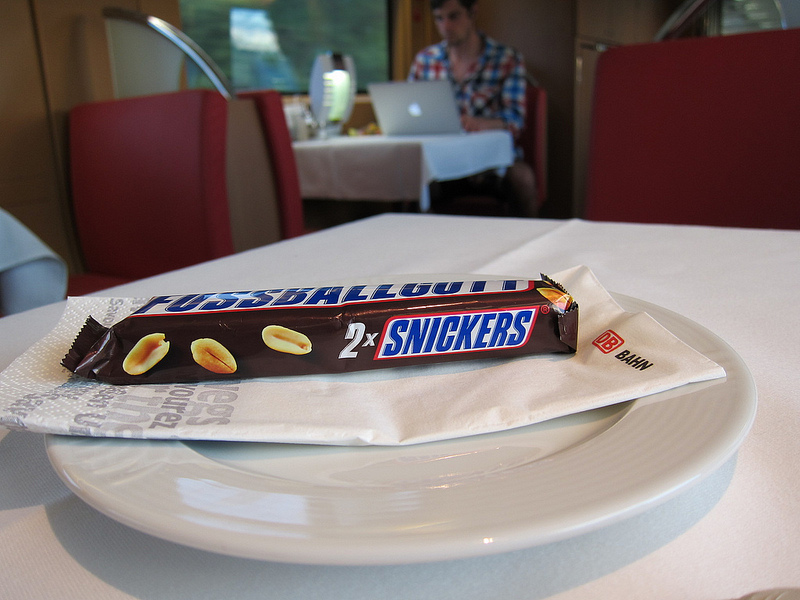
However, upon arriving in the dining car we were informed that there was a limited menu because of a malfunction in the kitchen. I ordered a Snickers bar, which was served on a plate. All that was missing was a knife and fork.

A Snickers bar served with a side dish of surreal. A fitting end to the trip.

Sunday, July 01, 2012

Bonn to Koblenz by bike


To me, a city's livability is directly related to its bikeablity. The easier it is to get in, out and around a city by bicycle, the happier I am to live there.

Bonn may not be the world's most dynamic city but what it lacks in excitement it makes up for in bikeability. The city is littered with bike lanes, bike paths, bike trails, bike stoplights, bike stores, bike rental shops, bike parking spaces, bike signs, bike routes and bike maps. (Unfortunately, being a paradise for cyclists also makes Bonn a paradise for thieves. Stories about stolen bikes are as ubiquitous as sauerkraut and sausages.)

Not only is it easy and safe to get around Bonn by bike, it's easy to ride from Bonn to other cities and towns in Germany (or to neighbouring countries, for that matter). Pretty much every region in Germany has a network of signposted bike routes. The country is criss-crossed by more than 200 long-distance trails covering 70,000 km, which makes it a perfect place for bike touring.

One of the first things I did when I arrived in Bonn was buy a bike. I've been itching to get out and do some cycle touring on the weekends but the weather wasn't cooperating. So when the forecast finally called for blue skies and warm temperatures yesterday, I decided to test out some of Germany's trails with a short 65 km ride down the Rhine from Bonn to Koblenz.


The nice thing about the ride was that it was almost entirely car-free. The majority of the route was down a bike path beside the Rhine, with a few back roads, forest trails and city streets thrown in for fun. The whole thing was well signposted with markers every few kilometres.


The best thing about the ride was that every 10 km or so, the path would cut through a small town on the banks of the Rhine, which meant plenty of opportunities for cake and coffee breaks. It took us more than seven hours to ride the 65 km to Koblenz. Of that, only four hours were spent in the saddle. The rest of the time was spent eating, relaxing and taking photos.


We arrived in Koblenz with enough energy to do some sightseeing before dinner. And, of course, no German bike adventure would be complete without capping it off with a tall, cold, German beer.


Heading back to Bonn was easy because bikes can be taken on trains in Germany. You can always ride one way and take public transport back. It's just one more layer of bikeability, which makes me happy to live here.