Showing posts with label Snow. Show all posts

Saturday, March 23, 2013

Awesome Austria


I've been in Germany for exactly one year now and the novelty of being transported to another country, climate and/or geographical zone by train still hasn't worn off. The smallness of Europe and the extensiveness of its rail network continue to amaze.

I'm not sure how much longer I'll be here but before I leave I'd like to complete my quest to travel to all nine countries that share a border with Germany, preferably by train. It's not that I have a burning desire to visit Luxembourg or Poland. But I like the sense of accomplishment that comes from making lists and crossing things off them. I also like circuitous challenges. And I like taking the train. Visiting all nine border countries combines the best of all three. The tally so far: Six countries down, three to go. Austria is the latest country scratched off the list.

Not that crossing a conveniently located country off an arbitrary list was the only reason to go to Austria at the end of February. There were other reasons too. Like the Alps, a shitload of snow and a joint birthday celebration.

I had a two-point plan to celebrate my birthday at the end of February. Sergey, who shares the same birthday, had a zero-point plan; he was up for anything. I wanted to trade Bonn's dark, soggy lowlands for somewhere more sunny, snowy and mountainous while, at the same time, setting foot in another German-border-sharing country. Austria was the obvious choice. Having settled on Austria, the next step was to find a place that offered every winter sport you could think of but mostly cross-country skiing. If you type "where in Austria can you find a place that offers every winter sport you can think of but mostly cross-country skiing?" into a Google search, you will not find a match. But if you type "cross-country skiing in Austria" into a Google search, you will find a place called Seefeld in Tirol.

Seefeld in Tirol claims to be the best place for cross-country skiing in all of Europe. Which seems like hyperbole but turns out to be fact. Seefeld in Tirol is located on a high plateau in the Austrian Alps with 279 km of groomed cross-country ski trails (154.3 km of trails for classic skiing and 124.7 km of trails for skate skiing). Basically it was a cross-country-skiing paradise. Which, for reasons I don't understand, seemed to attract a mostly older crowd. Like much older. Like 65+ older. If having an appreciation for silence and solitude on skis makes me old then so be it.


There were five villages within skiing distance so you could leave from Seefeld in the morning, ski all day, stop for lunch at one of the huts along the way, pop out in a different town and take the bus back. (Provided you didn't mind waiting for the bus, which ran only once an hour or sometimes not at all. But being in civilization, you could call a taxi to take you back.)

While skiing in Austria was incredibly beautiful, I wouldn't exactly call it a wilderness experience. The trails weaved in and out of forests but there were huts serving hot food and drinks every five kilometres or so. It was all very civilized. I especially enjoyed the complimentary blankets for coffee drinking.


Next weekend: A little trip to the little country of Luxembourg.

Tuesday, February 26, 2013

Gone skiing


I'm heading to the Austrian Alps for a birthday bonanza of skiing, skating and snowshoeing! Back online next week.

Sunday, February 17, 2013

The end of the backyard ice rink?


This is not a story about hockey. Hockey is a game and this goes deeper than that. Strip hockey of its teams, its salaries, its sticks, its pucks, its rules and its regulations. Take all of that away and you are left with what makes hockey possible in the first place. This is a story about ice.

Ice is a part of our collective Canadian consciousness. When I think about the winters of my childhood, I think about the hours spent skating on the tiny ice rink my dad built in our backyard. It was a simple bit of engineering with magical results.

My dad would wait until mid-December for temperatures to drop. After enough snow had fallen, he would clear an area of the backyard and use the snow to make banks around the rink. He repeatedly sprinkled water on the sides of the banks and on the edge of the grass in order to seal the area around the edges so that the water wouldn't leak out. After it had been cold enough for the ground to freeze, he used a hose to build up a base of ice.

Once we had a couple of inches of ice, he would "Zamboni" it by filling a large pail with warm water and flooding the rink. The warm water melted the surface and filled in all of the cuts from earlier skating. It probably took a week or two, depending on the weather, to create a good surface. Of course, thaws and rain would melt the rink but my dad would rebuild it as soon as it got cold again.

I couldn't get enough of that backyard rink. I would skate every day after school and go back out again after dinner. The sound the edge of the blade makes when it scrapes across the ice is etched into my bones.

The backyard ice rink is part of our narrative. But for how much longer? Will future generations of Canadian children be able to skate on homemade outdoor rinks or will it be a story we tell them about the way things used to be?

Climate change is transforming the world as we know it. This is not an exaggeration; this is a fact. Research shows that Canada's average winter temperature has increased 2.5 degrees Celsius in the past 70 years. According to Environment Canada, last year was the third-warmest winter in Canadian history.

Scientists in Montreal were the first to connect the dots between climate change and a shorter outdoor skating season. They looked at data from weather stations across Canada during the last 50 years and extrapolated that "at current rates, within four decades there will be very little to no outdoor natural skating in Canada with the exception of Winnipeg."

This prompted a group of geographers at Wilfrid Laurier University to create RinkWatch, a website where users can enter information about their rink's skate-ability and where researchers can track climate change. Associate professor Robert McLeman is hoping this will help people better understand large-scale environmental issues by placing them in their own backyard.

As he told the Ottawa Citizen, "When you talk about climate change and global warming, it's one of those big-picture ideas that people have trouble relating to on a personal or individual basis, so we thought, let's get kids and families to collect data about outdoor skating and use that as a bridge to pull them into citizen-engaged science."

It's great to see scientists who understand the importance of getting the public involved in their work. They're not just working to address climate change, they're working to make it matter to all of us. It's about making us less complacent by making us care.

Sunday, January 27, 2013

Cross-country ski porn


A modern twist on the old adage could go like this: if something seems too good to be true, it probably is, especially if you found it on the internet.

A search for a place to go cross-country skiing near Bonn last week turned up disappointing results. Most trails were closed because of a lack of snow and the few places that were open didn't rent skis. It wasn't looking good. And then, a few pages into the search results, an obscure website popped up promising snow, trails and rentals a little more than an hour drive southwest of Bonn. Not only that but it claimed to have a hut with a wood-burning stove and volunteer staff serving up hot chocolate and home-made cake. It seemed too good to be true.

We headed out yesterday morning with low expectations -- the website was probably out-of-date, surely there wasn't enough snow to ski on. But the place was close enough that we figured it was worth driving down to check it out and maybe, just maybe, it would turn out to be as good as advertised.

After a white-knuckle ride on the German autobahn (where the "recommended" speed limit is 130 km per hour, which drivers in the left lane interpret as the minimum speed rather than the maximum speed making the whole experience more terrifying than exhilarating) we arrived in a winter wonderland.

Located inside Eifel National Park, it seemed to have its own microclimate. A short hike through a snowy trail brought us to a hut in the middle of the woods where the use of the trails, skis, boots and poles for the day cost a total of nine euros. And taking a break to drink hot chocolate and eat home-made cake in front of the wood-burning stove in the hut? Indescribably good.

The trails went in and out of silent forests, and up, down and around Mt. Ernstberg (which at 698 metres is more of a bump than a mountain). I could tell you more about it but I'll let my photos speak for themselves.


Sunday, January 20, 2013

In defense of winter


Poor winter. The least appreciated of the seasons, it is written off as a hardship to endure or something to escape from.

Winter is described in menacing terms -- bleak, desolate, frigid, dark. We are caught in its teeth, in winds that bite and in snow that blinds. I don't deny the accuracy of this description but instead of making my heart sink, it makes it sing. I love winter. Always have, always will. The colder and snowier it is, the happier I am.

I'm talking about real winter, of course. Not this rainy, grey non-season that passes for winter in Bonn. Real winter means months of below-zero temperatures and snow that stays on the ground and piles up higher and higher with every successive snowfall. Real winter turns lakes and canals into skating rinks. Real winter stings the nostrils and fuses eyelashes together.

There is no season more beautiful, more romantic and more magical than winter. I love the way snow softens edges and muffles sound. I love the silence and the solitude. I love the minimalist beauty of a world turned white, so completely still it feels like a painting. I love seeing roads, trees and houses covered in snow while walking home at night. I love warming up frozen toes in front of a fireplace. I love that winter makes it okay to do nothing and go nowhere -- the only season that makes anti-social behavior socially acceptable.

I haven't outgrown the childlike sense of wonder at waking up to see snow outside the window. It still thrills me. It brings back happy memories of building snowmen, barreling down a hill on a toboggan, skating on a square of frozen ice, cross-country skiing out the front door and generally just spending hours outside playing in the snow.

Up until last week, winter in Bonn has been grey, gloomy, rainy and warm. While some people were fantasizing about flying south, I was seriously contemplating a trip to northern Norway to get my fix of real winter. I'd take the aurora borealis over a tropical beach any day.

But then something wonderful happened; it started snowing and it hasn't stopped. The temperatures have been below zero every day since Tuesday. Real winter has finally arrived in Bonn. And I couldn't be happier.

Sunday, February 19, 2012

Snow falling on cedars


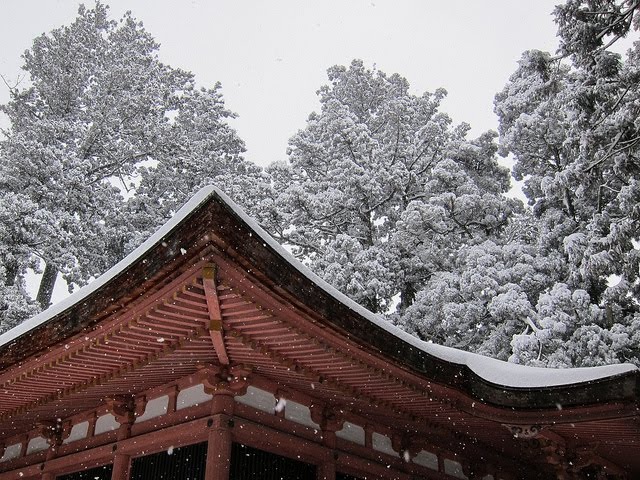
It hardly ever snows in Kyoto. Which is a good thing because there's only so much beauty a person can take. Winter in Kyoto is supposed to be a drab respite from the pink cherry blossoms in spring and the fiery maple leaves in fall. Winter is normally the off-season for beauty. But then, once or twice a year, it gets cold enough for the rain to turn to snow. And the result is magic.


Thursday, February 09, 2012

The joy of skiing in Japan


I used to think I knew what epic snow was. I was wrong. It turns out I didn't know what epic snow was until I set foot in the Japanese Alps.

We had left Kyoto at 11 p.m., riding the overnight bus northwest to Niigata prefecture. The lights were off, the curtains were closed, and the world outside the window was black. So when the bus arrived in the mountain town of Myoko seven hours later, none of us were prepared for what we were about to see.

The streets were lined with walls of snow two stories high. The rooftops were buried under snow three metres deep. The sky was dumping snow. Big, white flakes just pounding down from above. It piled up on our heads like scoops of ice cream while we were waiting for the driver to pull our luggage from the bowels of the bus. It was as if we had been magically transported to another world -- a world with so much snow it was almost suffocating.

I was travelling with a group of friends from all over the world, some of whom had never seen snow before moving to Japan. To them, this amount of snow was normal. It was what they saw in movies and, therefore, what they expected winter in a northern country would be like. But, for me, it was unbelievable. I had seen snow before but I had never seen snow like this before.


Interesting fact: Myoko averages 13 metres of snow each year. In comparison, Whistler receives an average annual snowfall of about 10 metres, while Banff receives about nine metres. Canada's snowiest cities (places like Montreal, St. John's, and Sudbury) top out at about two metres of snow each year. The reason for all of the snow along the western coast of Japan is due to the weather systems from Siberia that travel south across the Sea of Japan and pick up moisture as they go. Once over Japan, these weather systems meet the warm systems moving northward from the equator and the result is epic snow, unmatched anywhere else in the world. Between January and March, it almost never stops snowing. The deep powder makes Japan a paradise for skiers.


The ski resorts are western style but the apres ski scene is uniquely Japanese. A full day of skiing is followed by a long, hot soak in a rotenburo (open-air hot springs). I don't know what I like better: skiing through soft powder by day or sitting in a rotenburo in the midst of falling snow and rising steam by night. After bathing, you don't go out to a bar or a restaurant, you don slippers and a robe and head to a communal dining hall inside the hotel. By 7:30 p.m., everyone is back in their rooms for some chilled sake, or, in our case, cold umeshu (who needs ice when you can reach out the window and fill your cup with snow?). The day ends with the bliss of slipping into a fluffy futon on a tatami floor.


Travelling in Japan is unlike travelling anywhere else in the world. The country's top-notch customer service makes everything so easy, so efficient, so organized, it's like floating from one cloud to another. There was a dreamlike quality to our trip. The bus left on time and arrived on time. The lifts took us up the ski hill and gravity took us back down. We floated in the rotenburo and were swaddled and fed like babies afterward. There was nothing to think about and nothing to do except ski, eat, and sleep. The only intrusion into our bubble world was the snowplows that roared and beeped until midnight and started up again at 5 a.m.


We spent four days in Myoko, a tiny little ski town in the middle of Joshinetsu National Park. The town is nestled at the base of Mt. Myoko (2,454 metres) and Mt. Hiuchi (2,462 metres). There's not much on offer in-bounds for expert skiers but the resort is far away from the big crowds and the long lineups in Nagano and even further away from Niseko, which, according to everyone who has ever been there, is overrun by rude and obnoxious Australians. The longest lift queue in Myoko was about five minutes. Most of the time there was no queue at all. Going to Myoko meant sacrificing steepness for solitude. But it was a fair trade, especially for our group of newbie skiers from Brazil, Peru, Malaysia, Indonesia, and the Philippines.

I learned to ski in the ugly, industrial wasteland of Etobicoke, on a hill built on top of a giant garbage dump surrounded by Soviet-style apartment blocks. My dad took me there one snowy afternoon when I was about 10. He strapped a pair of skis on my feet, took me to the top of the hill, and gave me a push. Perhaps it's fitting that I learned to ski on a landfill because I still ski like garbage. My "technique" (if you can call it that) is to get down the mountain in one piece. Skiing is fun but, for me, the real joy comes from the beauty of the snow, the trees, and the mountains.


There's a misconception that skiing in Japan is expensive. If you don't mind sacrificing a few comforts, skiing in Japan can be extremely cheap. We each paid about $200 for our four-day trip, which included round-trip bus fare from Kyoto, lift tickets and equipment rentals for three days, two nights in a hotel, two dinners, and two breakfasts. Had we taken the bullet train instead of the overnight bus or asked for separate rooms instead of sharing one big room, the price would have been higher but it still would have been cheaper than skiing in Canada. At Whistler, it costs $96 just for a one-day lift ticket. Add in rental fees, transportation and food, and a single day at Whistler (nevermind a four-day trip) becomes prohibitively expensive.

Plus, by skiing in Japan, we got the added bonus of travelling back in time to 1984. The hotel, the rental equipment, and even the phone in our room were all relics from 30 years ago. It was like a living museum of the bubble years.


The gang from Kyoto University's Graduate School of Environmental Studies. From left to right: Jason from Malaysia, Glenn from the Philippines, Liliya from Bulgaria, Dani from Brazil, Violeta from Romania, Melina from Brazil, and me, representing Canada (not pictured: Angelica from Peru and Amir from Indonesia). A great trip with good friends.

Sunday, December 25, 2011

A red, orange and yellow Christmas


A lifetime of Canadian Christmases has conditioned me to think the only thing that should be hanging from the trees this time of year is icicles or twinkling lights.

It seems wrong that Kyoto is in the last blush of fall when trees back home have been bare for months. It's beautiful but it doesn't feel like Christmas.


Kyoto is a little bit like Vancouver. Both cities are surrounded by mountains where, if you get up high enough, the rain is replaced by snow. Still, there's something unnatural about walking through dry city streets and then arriving in a winter wonderland after an hour of hiking up the side of a mountain.

It's autumn at sea level and winter at elevation. Two seasons for the price of one.


Wednesday, June 30, 2010

A love letter to Canada


Dear Canada,

Happy 143rd birthday! Although, let's be honest, we both know you're much older than the 143 years the European settlers pretend you are. You may not have been a country in the legal sense of the word but people have called your land home for more than 20,000 years. Dinosaurs roamed across your plains long before we ever did.

The 143-year-old ruse reminds me of the way my mom continues to celebrate her 29th birthday 30 years running. But whatever. Today is not a day to point out your flaws. Today is a day to celebrate all of the wonderful and wacky things that make you so special.

You are so much more than maple syrup, hockey and poutine. You are not just snowshoes, canoes and barbeques. You are the rock beneath our feet. O Canada, how do I love thee? Let me count the ways . . .

1. Freedom: We are free to be whoever we want to be, say whatever we want to say, and wear whatever we want to wear. Other countries have burqas, bombs, and bullets. We have gay marriage, universal health care, and beer.

2. Diversity: We are a country of immigrants. We have different cultures, different religions, and different ideas but we all somehow manage to get along. We don't throw rocks at each other. We don't plant bombs outside busy markets. We don't believe in blowing each other up. We believe in human rights. We believe in tolerance. We believe a new citizen is every bit as Canadian as someone whose family has been here for five generations. Jamaican, Chinese, African, Indian, Australian . . . we are all Canadian.

3. Tim Hortons: A double-double and a chocolate dip to go, please.


4. Food: We can eat a burrito for breakfast, sushi for lunch, and souvlaki for dinner. A walk around the block is like a gastronomic trip around the world. But food from our own backyard is the best food of all. Blueberries, apples, pears, blackberries, corn, rhubarb, strawberries, potatoes, carrots, cherries, fiddleheads, and tomatoes. Just to name a few.

5. Wilderness: We have real wilderness in Canada. These vast, uninhabited areas are among the last remaining tracts of wilderness in the world. This is our national treasure and we should guard it with our lives. Canada does not just belong to us. It belongs to bears, moose, and caribou too.


6. The CBC: George Stroumboulopoulos, Claire Marin, Rick Mercer, Peter Mansbridge, Jian Ghomeshi, Anna Maria Tremonti, and good old Stuart McLean. The Hour, As it Happens, Definitely not the Opera, Vinyl Tap, A Propos, and The Current. The CBC is intelligent, funny, thoughtful, provincial, original, folksy, and fun. Sophisticated but not sleek. Polished but still a little amateurish. Just like us.


7. Manners: We are polite. We are friendly. We are humble. We are modest. We are unobtrusive. We say "sorry" a lot. We say sorry when you tell us to stop saying sorry all the time. (Sorry! We can’t help it.)

8. The four seasons: Lake swimming in summer, cross-country skiing in winter, walking under a canopy of red maple leaves in fall, and watching cherry trees bloom in spring.


9. Film and TV: FUBAR and Exotica. Degrassi and the Trailer Park Boys. We turn low budgets into brilliant art. Just giv'r!

10. Space: We are a big country with a small population. We can drive for days and still be in the same province. We can walk into the woods and not see another person for months. We live in towns so remote you can only get there by boat or plane. Our biggest cities aren't big at all. Thirty-four million people live in Canada. Thirty-four million people live in the Greater Tokyo Area.

Happy Birthday, Canada! You ancient, rocky, sexy hunk of land you!