Sunday, July 01, 2012

Bonn to Koblenz by bike


To me, a city's livability is directly related to its bikeablity. The easier it is to get in, out and around a city by bicycle, the happier I am to live there.

Bonn may not be the world's most dynamic city but what it lacks in excitement it makes up for in bikeability. The city is littered with bike lanes, bike paths, bike trails, bike stoplights, bike stores, bike rental shops, bike parking spaces, bike signs, bike routes and bike maps. (Unfortunately, being a paradise for cyclists also makes Bonn a paradise for thieves. Stories about stolen bikes are as ubiquitous as sauerkraut and sausages.)

Not only is it easy and safe to get around Bonn by bike, it's easy to ride from Bonn to other cities and towns in Germany (or to neighbouring countries, for that matter). Pretty much every region in Germany has a network of signposted bike routes. The country is criss-crossed by more than 200 long-distance trails covering 70,000 km, which makes it a perfect place for bike touring.

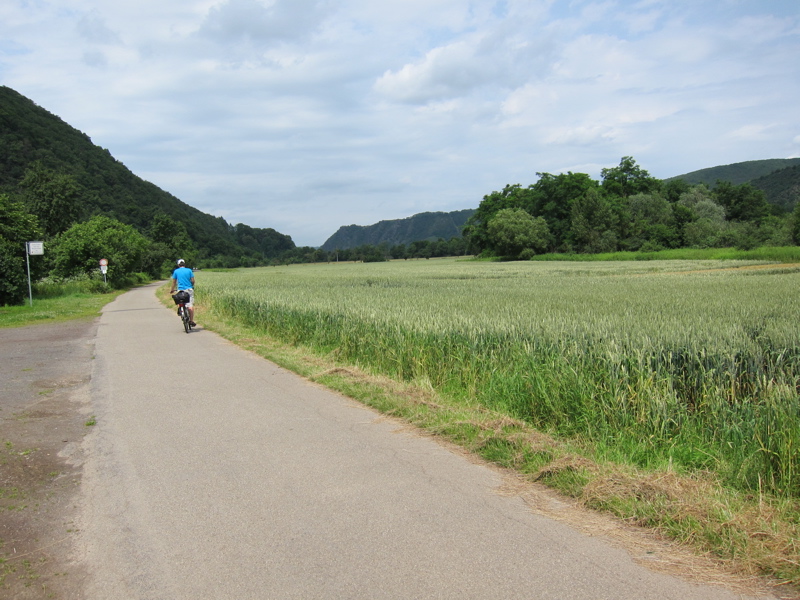
One of the first things I did when I arrived in Bonn was buy a bike. I've been itching to get out and do some cycle touring on the weekends but the weather wasn't cooperating. So when the forecast finally called for blue skies and warm temperatures yesterday, I decided to test out some of Germany's trails with a short 65 km ride down the Rhine from Bonn to Koblenz.


The nice thing about the ride was that it was almost entirely car-free. The majority of the route was down a bike path beside the Rhine, with a few back roads, forest trails and city streets thrown in for fun. The whole thing was well signposted with markers every few kilometres.


The best thing about the ride was that every 10 km or so, the path would cut through a small town on the banks of the Rhine, which meant plenty of opportunities for cake and coffee breaks. It took us more than seven hours to ride the 65 km to Koblenz. Of that, only four hours were spent in the saddle. The rest of the time was spent eating, relaxing and taking photos.


We arrived in Koblenz with enough energy to do some sightseeing before dinner. And, of course, no German bike adventure would be complete without capping it off with a tall, cold, German beer.


Heading back to Bonn was easy because bikes can be taken on trains in Germany. You can always ride one way and take public transport back. It's just one more layer of bikeability, which makes me happy to live here.


Sunday, May 06, 2012

Where have all the comments gone?

As of tonight, I've pulled the third-party commenting system I've been using for the past several years off my blog. The company that hosted the comments announced that it will discontinue its service in October so I decided to go back to the original commenting system built into this blog.

Unfortunately, making the switch meant losing thousands of thoughtful, helpful, insightful, funny and touching comments that have been posted on this blog since 2005. All of the comments are gone. I'm gutted. I really am.

Ever since I've been in Germany, I haven't been able to read and reply to your comments because of a glitch in the commenting system. I didn't want to wait until October to replace it. So it had to go. I only wish your comments didn't have to go along with it.

Tuesday, May 01, 2012

First impressions (second time around)


When you live in Japan, it's easy to forget how chatty people in other parts of the world can be. Striking up a conversation with the cashier as she scans your groceries simply isn't done in Kyoto. I've never seen anyone ask a clerk at 7-Eleven how his day is going. I've never seen a train attendant stop to chat with passengers about the weather. I've never overheard a salesgirl crack a joke with a customer. There's a distance and a quietness among strangers in Japan, rather than the jovial, overly familiar banter we're used to in the west.

So it came as a shock when I arrived in Germany and found myself surrounded by people who made small talk seem as natural as breathing. At the Frankfurt airport, I had more conversations with random strangers in 30 minutes than I'd had in three-and-a-half years in Japan.

The customs officer asked me questions about what I was doing in Germany and how long I planned to stay (technically, this conversation may have been part of his job but the tone was more chatty than interrogative). A Brazilian passenger told me about his ski trip all the way to the baggage area. At the baggage area, an airport employee took it upon himself to give me the weather forecast for the week. On the train to Bonn, the guy sitting next to me gave me an impromptu lecture on German cuisine. He described the many varieties of German bread and told me that apple juice mixed with sparkling water, not beer, was his countrymen’s beverage of choice. When the train attendant asked if we would like some chocolate, his eyes shone and he knowingly said, "Ah, German chocolate. Best chocolate in the world." His face fell when she handed me a Snickers bar (presumably not the kind of chocolate he was referring to).

But the chattiness doesn't end there. It's a constant thing. When I walk down the street, people stop me to ask for directions. When I stand in line at the grocery store, someone will turn to me and make an offhand remark about the length of the line up or last night's soccer game or their eye medication or who knows what.

This friendly banter among strangers is nice but the problem is that all of these conversations are in German and I can't speak German. Smiling, nodding and saying, "ja, ja, ja" will only get you so far. The small talk I dread the most is the kind that comes with a raised voice at the end of a sentence. A question means I have to come clean and admit that I can't speak German. I hate having to say that I can't speak German in English. It makes me feel self-conscious and rude. Whenever I say, "Sorry, I can't speak German" I'm worried the other person will interpret this as, "I will live in your country. I will work in your country. But I won't learn your language. I will speak English and so will you."

So, learning German is a priority. In the meantime, I asked a German colleague to teach me how to say, "I can't speak German" in a way that implies I want to learn German but haven't gotten around to it yet. She wrote down the following phrase: Ich spreche noch nicht gut Deutsch, konnen wir Englisch sprechen? I've memorized the words but the pronunciation (a roller-coaster of larynx-twisting sounds that gargle up from the throat to the mouth and back down again) is another story.

Aside from the chattiness and the language barrier, there are other things that are still new and exciting. Like the bike lanes on almost every street (and the cute little stoplights just for cyclists with their red, yellow and green bicycle lights). Or the fact that you can get organic food pretty much everywhere, even at the drugstore. Or the fact that my apartment has a shower inside the apartment and you don't need to feed coins into a machine to use it. Also, I now have a stove with four burners instead of one. It excites me that I can cook pasta and sauce at the same time. Cooking with a one-burner stove and no oven for three-and-a-half years was tedious, time-consuming and required a lot of creative energy. Now that I have a four-burner stove again, I have no idea how I survived without it.

On the negative side, I was surprised to discover that there is a thriving neo-Nazi scene in Germany. But here's the shocking thing: not only are there neo-Nazis but they also have parades and actually show their faces in public. I would have thought being a neo-Nazi in 2012 was the sort of thing you'd want to keep on the down low. Isn't it kind of embarrassing to march through the streets and publicly out yourself as a right-wing extremist?

There was a neo-Nazi parade in Bonn today and I went because I didn't know that neo-Nazis still existed and I wanted to see them with my own eyes (and to support to the counter demonstration, of course). However, I didn't actually get to see any neo-Nazis because there were so many anti-neo-Nazi demonstrators blocking the parade route that police put up barricades to prevent the anti-neo-Nazis from getting within 50 metres of the neo-Nazis. Thousands of people turned up to try to stop the neo-Nazi parade so that's a good thing. Here they are giving neo-Nazis the finger.


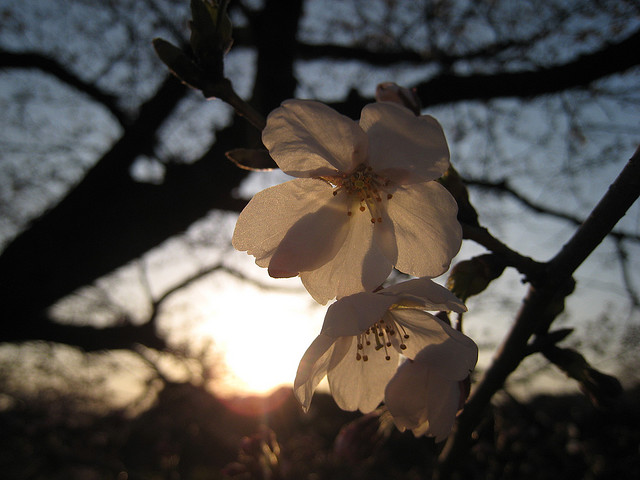
On a lighter note, I was also surprised to learn that there are cherry blossoms in Bonn. I was upset about missing the cherry blossom season in Japan. But when I arrived in Bonn, the blossoms were already here, waiting to welcome me to my new home.

Sunday, April 22, 2012

Leaving Japan


How do you condense three and a half years into a few hundred words? I could fill a book with the highs and lows of my life in Japan. But I need time to digest the experience and time isn't something I've had a lot of recently.

My last few weeks in Japan were divided between the tedious task of packing up and moving out of my apartment and the painful task of saying goodbye to friends. And then, before I knew it, I was flying to Germany and reporting for duty at work the next day. No gentle transition. No buffer. No time to process the fact that Kyoto was no longer home. My life in Japan ended as abruptly as my life in Germany began.

Just to give you an idea of how quickly everything happened, I had a meeting with one of the HR assistants on my first day at work and she asked me to provide copies of various documents, including my master's degree from Kyoto University. I had to explain that I couldn't give her a copy of my master's degree because I hadn't actually graduated yet -- I had started working before the ink on my thesis was dry. (As happy as I am to be working at the UNFCCC, missing my graduation ceremony was a bitter pill to swallow.)

From the moment the plane touched down in Frankfurt, I was caught up in the general busyness that accompanies moving to a new country -- looking for an apartment, moving into an apartment, getting a cell phone, opening a bank account, buying a bike, figuring out where everything is, adjusting to the new job, and learning a few German phrases (this is a work in progress. I haven't moved beyond "good morning" and "thank you" yet). I've been in Bonn for a month now and this is the first weekend I've finally had time to reflect on my life in Japan.

The strange thing is that I don't miss Japan. Not yet. Everything here is still too new, too exciting, too time consuming. Maybe it will hit me in a few months when I've settled into a routine. Or maybe it won't hit me at all. I've already mourned the loss of living in Japan once before. The first time I left Japan, I cried every day for a month. I had only been there for a year and I regretted my decision to leave, which is why I went back. But it was a completely different experience the second time around.

The first time I lived in Japan, I was in a rural area and embedded in the local community. It was an incredible experience but it was also a lonely and isolating one. I would swing between extreme highs and lows. I felt like I was living in the proverbial fishbowl -- everyone knew what I was doing at all hours of the day, every day. There was no privacy. Kids from school would follow me home and press their faces against my kitchen window as I cooked dinner. Old ladies would follow me around the supermarket, muttering about the food I was putting into my basket.

Living in Kyoto was nothing like living in rural Japan. It was easy to slip into the crowd and live anonymously. I spent more time with foreigners than with Japanese people. By not fully integrating into the community the way I had done in Sakawa, I created a buffer that protected me from feeling lonely and isolated. I never experienced the high highs or low lows that I did in Sakawa, but I had deeper friendships in Kyoto and was much happier as a result. You learn a lot about yourself when you live in a foreign country and sometimes these things surprise you. I always thought of myself as an introverted person but I clearly need to feel a sense of belonging to be happy. If I have a group of good friends around me, I can feel at home anywhere. The importance of feeling connected seems obvious but it took a year of solitary confinement to drive the point home.

This time around, I was ready to leave Japan. The rigidity, the inflexibility, the blind adherence to the rules, the mindless consumerism, the conservatism, the conformity, the feeling of being treated like an outsider no matter how long you’ve lived there, the expectation that you will put everything and everyone ahead of yourself and that you will sweep the mental and physical effects of doing so under the rug was starting to wear me down. But, of course, that's all objective stuff. Emotionally speaking, I'm not sure I'll ever be able to detach myself from Japan. I see Japan with open eyes. I see the good things and I see the bad things and I still love it.

The first time I left Japan, I made a list of the things I would and wouldn't miss about living there. The list still holds true today but with a few additions.

I will miss Japanese food. Not the kind of Japanese food that immediately comes to mind, like sushi or ramen. But the simple things like a square of chilled tofu topped with grated ginger and green onions. Or thin slices of gobo dressed with sesame oil. Or miso soup with mountain vegetables. Or a little box of natto for breakfast. Or even just a cup of green tea.

I will miss traveling in Japan. I have yet to visit a country that is as easy, safe or comfortable to travel in as Japan. I will miss sitting on the train watching the ramshackle houses fly by. I will miss the deserted shrines and temples on misty mountain tops. I will miss the empty hiking trails. I will miss the way people worship cherry blossoms in the spring and maple leaves in the fall. I will miss the vibrant green colour of the rice fields in the summer. I will miss hearing the mating calls of frogs that call the rice fields home. I will miss seeing the fireflies along the river on hot summer nights. I will miss hearing the scream of the cicadas. I will miss hearing the wind rush through a forest of bamboo trees. I will miss Japan at its best -- a mystical, magical place where it sometimes feels like you're living in a dream.

I want to say that Japan is no better or worse than any other country. It has its good points and its bad points. And while this is true, there is something just a little bit extra special about Japan. And that's something I will keep with me forever, even as I let go of living in Japan and move forward in Germany.

Sayonara and arigatou.

Monday, March 12, 2012

Chocolate with a side order of cat


There are many things I will miss about Japan but there are few things I will miss more than cat cafes. Nothing beats sipping a cup of coffee while curling up with a cat or two (or 10).

One of the best places to drink coffee while petting a cat is the Kyoto Nama Chocolat Organic Tea House. It's not officially a cat cafe but it is a cafe and there is a cat inside so, unofficially, it's a cat cafe. The place is run by a Canadian woman and her Japanese husband, who was the former chef for the Japanese ambassador in New York City. Their hand-made chocolate is light, delicious, and fresh. It's good. Really, really good. (The cat is their family pet.)

Cats, chocolate, and coffee all under one roof. It doesn't get much better than that.


Tuesday, March 06, 2012

"You're hired!"


It's official: I got a job with the United Nations Climate Change Secretariat! I report for duty on March 19th, which gives me exactly two weeks to pack up my life in Japan and move to Germany.

I'll be an associate programme officer with the capacity-building and outreach team ("capacity-building" refers to helping developing countries build, strengthen, and improve their capacity to mitigate and adapt to climate change, while "outreach" refers to reaching out to various stakeholders, including young people and intergovernmental organizations).

But I can't get too excited yet. I still have to clear two hurdles before the job offer officially becomes official. The first hurdle is passing the UN medical exam. The exam is intense (and, under Canadian employment law, totally illegal. It took me a few days to get comfortable with the invasive nature of the questions). I have completed about half of the exam so far: chest x-ray, blood samples, urine test, eye test, blood pressure, height, weight, electrocardiogram, family history, self-evaluation, and a colorblindness test (I passed! Does this mean I get to fly a plane?). The second half includes a full physical with a doctor (including a rectal exam). The exam leaves no orifice unprobed. I can understand the necessity of the exam for UN employees working at a refugee camp or in a war zone but it seems a bit over-the-top for a desk job in Germany.

Some of the more questionable questions on the medical exam include the following: "Have you ever been absent from work for longer than one month through illness?" "Have you ever consulted a neurologist, a psychiatrist or a psychoanalyst?" "Have you ever suffered from gonorrhea?" "Do you smoke regularly?" "Are your periods regular? Are they painful? Do you have to stay in bed when they come?" "Have you gained or lost weight during the last three years?" (Seriously!?) In Canada, this would be fodder for a human rights tribunal. I trust that they're not using this information to discriminate against people who are mentally ill or HIV positive or physically disabled. I assume it's just a way to ensure workers in extreme conditions (like the aforementioned war zone) are able to endure mental and physical stress and/or to provide support and services for staff members who need it. (The UN medical exam is posted online so it's not some sort of secret. It's all very transparent and above board.)

Once I got over the initial shock, I realized it's probably a good thing that they're forcing me to take a medical exam since I rarely ever go to the doctor. If something is wrong, it will be good to catch it early. I'm just not sure how the UN defines "healthy" and if I'll measure up. If I fail the medical exam, the job offer will be withdrawn.

The second hurdle is if the German authorities refuse to issue me an entry visa. I'm pretty sure all of this will be a non-issue but the job is not a sure thing until I pass these two hurdles. So I have to temper my excitement. Plus, my general strategy in life is to always expect the worst. That way, when the worst doesn't happen, I'll always be pleasantly surprised. The way I see it, death, dismemberment, illness, heartbreak, and disappointment are always right around the corner. These things follow you around like a shadow, waiting to surprise you when you least expect it. So I live my life knowing that good health and good luck are only temporary constructs that will eventually run out. I've been on a lucky streak for a long time and I fully intend to enjoy it while it lasts.

Wednesday, February 29, 2012

Field trip


It's coming up to the end of the fiscal year here at Kyoto University, which means only one thing: it's time to burn some money!

Our graduate school traditionally gets rid of leftover money in the budget by cooking up an all-expenses-paid trip for students under the guise of "research" or "internationalization." I'm not complaining; I love these annual junkets. The trips include free transportation, free food, free hotel room, and free fun.

This year's junket was a trip to Wakayama prefecture to learn about life in a coastal community. Our itinerary included a stop at a farmer's market, an afternoon at a fishing village, a tour inside traditional wooden houses, a stay at an onsen hotel, a trip to Kyoto University's Shirahama aquarium, and a walk along the Sandanbeki cliffs.

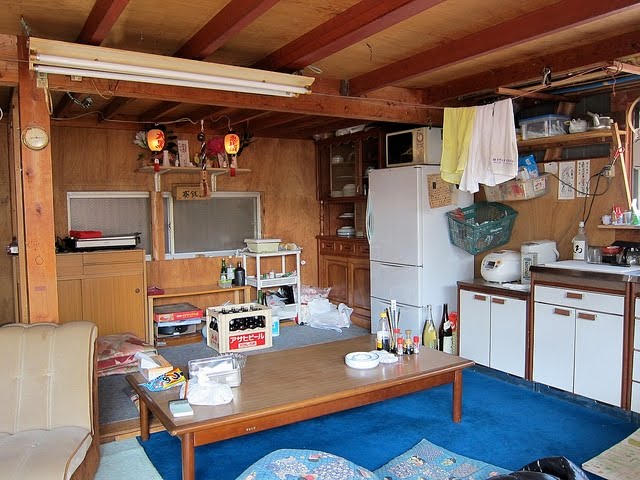
We were supposed to visit the port to watch local fishermen unload their catch but when we arrived, the fishermen had nothing to show us because the fish weren't biting. As a consolation, they offered to take us to their man cave.


The man cave was originally a storage shed. The fisherman who owned the shed had a rocky relationship with his wife, so when they were fighting, he'd sleep in the shed. At some point, a few other unhappily married fishermen started to sleep in the shed too. The shed became a natural gathering place for the fishermen, so the owner decided to fancy it up. He put down flooring, installed a kitchen, got a cable hookup, crammed in a few sofas, bought several cases of beer, and turned it into a proper man cave. The owner invited us inside and showed us a home movie, which consisted of some very old, very drunk men singing some very off-key songs. As we were leaving, one of the fisherman gave us some grandfatherly advice on how to enjoy the evening, "Get drunk and then pass out!"

After we left the man cave, we visited some traditional wooden houses in the old part of town. This was probably my favourite part of the trip, since I love snooping inside strangers' houses.


These were not museums. These were real houses with real people living inside them. I have no idea why the local people would allow a group of about 20 foreign students to go tramping through their homes but they seemed to enjoy the attention. One of the homeowners tipped off the local newspaper and a journalist showed up to take pictures and interview one of our professors. It must have been a slow news day.

We spent the night at an onsen hotel in the resort town of Shirahama (which can only be described as the Jersey Shore of Japan). The hotel, a monstrosity built during the bubble years, smelled of stale cigarette smoke. But the food was free, the onsen was hot, the yukatas were cute, and the futons were fluffy. Free trips don't get better than that!


This sign was interesting. I was curious to know what was hidden underneath the "water for smooth, firm shining skin" sticker. Glenn suspected the original offer was for a bottle of booze, which had to be changed after the town joined the nation-wide "stop drunk driving" campaign.


In addition to "water for smooth, firm, shining skin," you can also get whale skin in Shirahama.


If the view is obscured by fog or clouds, you can pose for photos against this backdrop. Your family and friends will never know the difference!

Wednesday, February 22, 2012

PhD fail


These are the results of the PhD entrance exam. If your number is on the page, you pass. If your number is not on the page, you fail. My number is not on the page.

The reason I failed is because I didn't take the Test of English as a Foreign Language (TOEFL) in time. All prospective students are required to take the TOEFL since our graduate school is -- theoretically at least -- in English. (In reality, the majority of classes are in Japanese, the students write their reports and give presentations in Japanese, the professors give lectures in Japanese, the office sends out information in Japanese, and the mountain of paperwork we have to fill out on a regular basis is in Japanese. Ironically, the PhD results were posted in Japanese, which meant I needed to use Japanese to find out I had failed because of my English.)

The PhD exam was scored out of 400 points. The points were divided evenly between your English ability (based strictly on your TOEFL score) and the quality of your presentation. You needed 50 per cent overall to pass. The scoring system is set up in a way that someone with a good TOEFL score and a lousy presentation can pass the PhD entrance exam. On the other hand, someone with a low TOEFL score and an excellent presentation can fail the PhD entrance exam.

I got zero points for my English ability and a high score for my presentation. But because I didn't get a perfect score on my presentation, I didn't have enough points to reach the 50 per cent baseline needed to pass. Two members of my interview panel were willing to give me a perfect score on my presentation but the third professor was not. This is where things get tricky.

The two professors who were willing to bend the rules were both foreigners. They thought the TOEFL requirement for native English speakers was an embarrassingly stupid rule and they were willing to bend it. But they were both lower ranking than the third member of the panel, who was a Japanese engineering professor I had never met before. (It's a mystery as to why a civil engineer would be chosen to judge a candidate hoping to become a specialist in the field of ecological literacy.) He ended up giving me a less-than-perfect score for my presentation, which was probably the right thing to do. Objectively speaking, my presentation didn't deserve a perfect score. But by giving me a lower score, he knew I would fail the entrance exam. He wouldn't be failing me based on my suitability as a PhD candidate, he'd be failing me because I didn't take the TOEFL on time. There was no room for compassion or common sense.

Rigidity is a fact of life in Japan. This is not entirely a bad thing. Rigidity has its benefits -- trains that run on time, fantastic customer service, and an attention to detail that you just don't find anywhere else in the world. As a foreigner, you either accept the way things are done here or you don't. Ultimately, the responsibility for failing the PhD entrance exam falls on my shoulders. I should have taken the TOEFL. I've lived in Japan long enough to know that the rules are too rigid to bend.

I'm not upset about any of this. I mean, I was upset at first but I'm not anymore. In fact, I now think it's a good thing I failed. I think by leaving the TOEFL too late, I had already subconsciously decided that I didn't want to stay in Japan and do a PhD. At the same time, part of me was attracted to doing a PhD because I was passionate and excited about the research I was doing for my master's thesis and I wanted to keep it going. I was on a full scholarship that paid me to be a full-time student; it would have been easy to slide from the master's program into the PhD. But it now seems clear that the easy choice would have been the wrong choice.

With only a month to go before I graduate, I want the all of the good things about my time in Japan to be what stays with me. Despite the occasional setback, my experience here has been overwhelmingly positive. To be paid to be a full-time student is a rare privilege. It seems petty to complain about a silly rule.

Besides, the frequent ups and downs are what make life in Japan interesting. Being confronted with different ways of thinking forces you to examine your own way of thinking. Why do you see the world this way, and not that way? Why do you value this, but not that? Being an outsider allows you to see the way people have been culturally conditioned to think and act, which, in turn, allows you to see the way you have been culturally conditioned to think and act. Living in Japan has broadened my mind. And that's something that will stay with me forever. It will be difficult to leave Japan but I'm ready to move on. New opportunities and adventures await!

Sunday, February 19, 2012

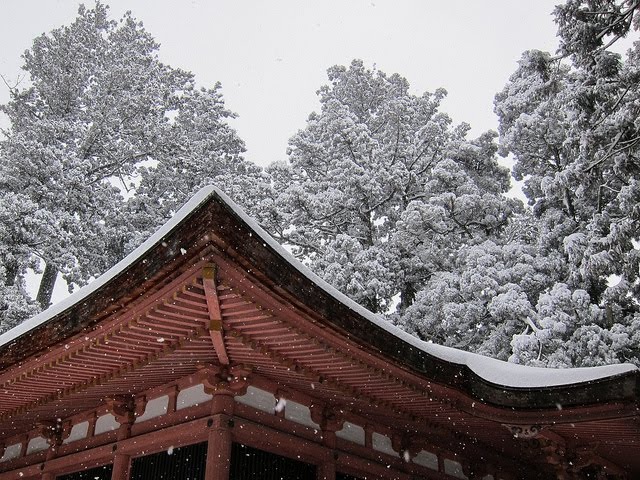
Snow falling on cedars


It hardly ever snows in Kyoto. Which is a good thing because there's only so much beauty a person can take. Winter in Kyoto is supposed to be a drab respite from the pink cherry blossoms in spring and the fiery maple leaves in fall. Winter is normally the off-season for beauty. But then, once or twice a year, it gets cold enough for the rain to turn to snow. And the result is magic.


Sunday, February 12, 2012

Now what?


With less than a month to go before the final deadline to submit my master's thesis, people have been asking me what I plan to do after I graduate. Initially, I told them the truth: I don't know. I figured I'd figure it out after April.

But the best-laid plans often go awry, especially when your plan is to have no plan at all. Former supervisors sent job postings my way, encouraging me to apply, while my professors pressured me to stay on for a PhD. So now my problem is not a lack of choices; my problem is too many choices. I have three different options to choose from, all of them equally enticing.

Option 1: Work at the UNFCCC in Bonn

I have a job interview with the UNFCCC tomorrow night. The job title is long (Associate Programme Officer, Capacity-building and Outreach Unit, Financial, Technology and Capacity-building Programme) and the contract is short (six months). But it's a great opportunity to work on an issue I care about, learn something new, and broaden my skill set. I'm not sure what my chances of actually getting the job are; I have a feeling the competition will be fierce.

I did a four-month internship with the UNFCCC in 2010 and I took on a six-week consulting position in 2011. So I know what I'm getting into. The job will be stressful and the workload will be heavy. But the people are great, Bonn is lovely, and the work is interesting. An added bonus is that Sergey has an EU passport, which means he can live and work in Bonn. There are lots of positives. But I don't see myself being in Germany for the long haul. It's a nice place to visit but I don't want to settle down there. My heart belongs to Canada's open spaces and wild places.

Option 2: Stay at Kyoto University and do a PhD


I took the PhD entrance exam for the Graduate School of Global Environmental Studies yesterday. I'll find out on February 20th if I've been accepted and I'll find out on March 1st if my scholarship has been extended. If my scholarship isn't extended, I won't stay on for the PhD. I don't want it badly enough to pay for it.

Unfortunately, the entrance exam was a bit of a disaster. It left me feeling demoralized and questioning whether I'm really suited to do a PhD. Not only did I get ripped apart for my lack of training in quantitative research but I got zero points for my English ability, which could put my overall score near the bottom of the list.

The reason why I got zero points for English is because I didn't take the Test of English as a Foreign Language (TOEFL) in time. All prospective students are required to take the TOEFL but I figured there would be an exemption for native English speakers. Of course, I should have known rational thinking was no match against the Japanese system of institutionalized inflexibility and blind adherence to the rules, no matter how stupid or illogical the rules may be.

I'm still not sure why a native English speaker would be required to fork over $250 to take a test that measures their ability of English as a foreign language. Especially when that person grew up in an English-speaking household in an English-speaking country, attended English-speaking schools, worked as a journalist for an English-language newspaper, and worked as a communications specialist for an English-speaking NGO. (The fact that I was given zero points for my English ability is so absurd as to be humorous. But this is neither here nor there. It's my own fault for leaving the English test too late. I've lived in Japan long enough to know that the rules are too rigid to bend.)

It's stuff like this that makes me question whether I can handle another three years in Japan. But, despite the occasional setback, my experience here has been overwhelmingly positive. Loving Japan is no different than loving anything else: there are days it will irritate the hell out of you, and there are days it will make you so happy your heart feels like it will burst.

I like the idea of continuing the research I started with my master's thesis. Doing a PhD means I'll get to attend conferences and write research papers. I'll learn a lot and I'll get to set my own hours while doing it. Another three years here could be nice. Or it could be horrible.

Option 3: None of the above

If I don't get the job with the UNFCCC and if I don't pass the PhD exam or if my scholarship isn't extended, then I'm going to take six months off and just enjoy life. (Every time I tell people about Option 3, I get the same reaction: "Oooooh! I like this option the best!")

I'll go back to Canada in April and spend a month with my family in Toronto. Then I'll cross the country, visiting my sisters in Halifax, Yellowknife and Nelson. I'll catch up with friends in Vancouver, Montreal and St. John's. Finally, I'll head to Bulgaria for three months to spend time with Sergey. If our relationship is still going strong after that, we'll probably move to Canada together. If not, I'll be heading home alone. No job, no boyfriend, and no regrets.

It scares me to think that I will have a definitive answer to the question "what are going to do after you graduate?" within a few weeks. I don't know why but knowing what I'm going to do after I graduate is more terrifying than not knowing what I'm going to do.

Thursday, February 09, 2012

The joy of skiing in Japan


I used to think I knew what epic snow was. I was wrong. It turns out I didn't know what epic snow was until I set foot in the Japanese Alps.

We had left Kyoto at 11 p.m., riding the overnight bus northwest to Niigata prefecture. The lights were off, the curtains were closed, and the world outside the window was black. So when the bus arrived in the mountain town of Myoko seven hours later, none of us were prepared for what we were about to see.

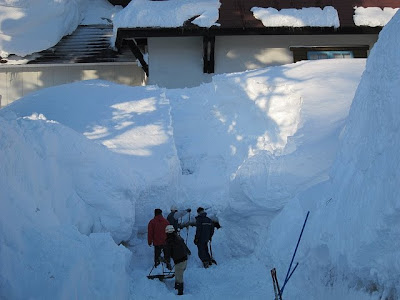
The streets were lined with walls of snow two stories high. The rooftops were buried under snow three metres deep. The sky was dumping snow. Big, white flakes just pounding down from above. It piled up on our heads like scoops of ice cream while we were waiting for the driver to pull our luggage from the bowels of the bus. It was as if we had been magically transported to another world -- a world with so much snow it was almost suffocating.

I was travelling with a group of friends from all over the world, some of whom had never seen snow before moving to Japan. To them, this amount of snow was normal. It was what they saw in movies and, therefore, what they expected winter in a northern country would be like. But, for me, it was unbelievable. I had seen snow before but I had never seen snow like this before.


Interesting fact: Myoko averages 13 metres of snow each year. In comparison, Whistler receives an average annual snowfall of about 10 metres, while Banff receives about nine metres. Canada's snowiest cities (places like Montreal, St. John's, and Sudbury) top out at about two metres of snow each year. The reason for all of the snow along the western coast of Japan is due to the weather systems from Siberia that travel south across the Sea of Japan and pick up moisture as they go. Once over Japan, these weather systems meet the warm systems moving northward from the equator and the result is epic snow, unmatched anywhere else in the world. Between January and March, it almost never stops snowing. The deep powder makes Japan a paradise for skiers.


The ski resorts are western style but the apres ski scene is uniquely Japanese. A full day of skiing is followed by a long, hot soak in a rotenburo (open-air hot springs). I don't know what I like better: skiing through soft powder by day or sitting in a rotenburo in the midst of falling snow and rising steam by night. After bathing, you don't go out to a bar or a restaurant, you don slippers and a robe and head to a communal dining hall inside the hotel. By 7:30 p.m., everyone is back in their rooms for some chilled sake, or, in our case, cold umeshu (who needs ice when you can reach out the window and fill your cup with snow?). The day ends with the bliss of slipping into a fluffy futon on a tatami floor.


Travelling in Japan is unlike travelling anywhere else in the world. The country's top-notch customer service makes everything so easy, so efficient, so organized, it's like floating from one cloud to another. There was a dreamlike quality to our trip. The bus left on time and arrived on time. The lifts took us up the ski hill and gravity took us back down. We floated in the rotenburo and were swaddled and fed like babies afterward. There was nothing to think about and nothing to do except ski, eat, and sleep. The only intrusion into our bubble world was the snowplows that roared and beeped until midnight and started up again at 5 a.m.


We spent four days in Myoko, a tiny little ski town in the middle of Joshinetsu National Park. The town is nestled at the base of Mt. Myoko (2,454 metres) and Mt. Hiuchi (2,462 metres). There's not much on offer in-bounds for expert skiers but the resort is far away from the big crowds and the long lineups in Nagano and even further away from Niseko, which, according to everyone who has ever been there, is overrun by rude and obnoxious Australians. The longest lift queue in Myoko was about five minutes. Most of the time there was no queue at all. Going to Myoko meant sacrificing steepness for solitude. But it was a fair trade, especially for our group of newbie skiers from Brazil, Peru, Malaysia, Indonesia, and the Philippines.

I learned to ski in the ugly, industrial wasteland of Etobicoke, on a hill built on top of a giant garbage dump surrounded by Soviet-style apartment blocks. My dad took me there one snowy afternoon when I was about 10. He strapped a pair of skis on my feet, took me to the top of the hill, and gave me a push. Perhaps it's fitting that I learned to ski on a landfill because I still ski like garbage. My "technique" (if you can call it that) is to get down the mountain in one piece. Skiing is fun but, for me, the real joy comes from the beauty of the snow, the trees, and the mountains.
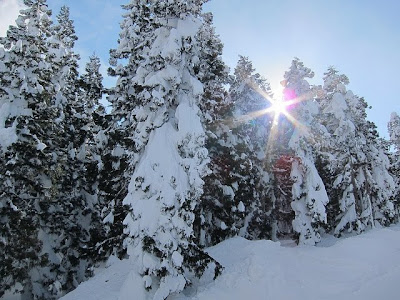


There's a misconception that skiing in Japan is expensive. If you don't mind sacrificing a few comforts, skiing in Japan can be extremely cheap. We each paid about $200 for our four-day trip, which included round-trip bus fare from Kyoto, lift tickets and equipment rentals for three days, two nights in a hotel, two dinners, and two breakfasts. Had we taken the bullet train instead of the overnight bus or asked for separate rooms instead of sharing one big room, the price would have been higher but it still would have been cheaper than skiing in Canada. At Whistler, it costs $96 just for a one-day lift ticket. Add in rental fees, transportation and food, and a single day at Whistler (nevermind a four-day trip) becomes prohibitively expensive.

Plus, by skiing in Japan, we got the added bonus of travelling back in time to 1984. The hotel, the rental equipment, and even the phone in our room were all relics from 30 years ago. It was like a living museum of the bubble years.


The gang from Kyoto University's Graduate School of Environmental Studies. From left to right: Jason from Malaysia, Glenn from the Philippines, Liliya from Bulgaria, Dani from Brazil, Violeta from Romania, Melina from Brazil, and me, representing Canada (not pictured: Angelica from Peru and Amir from Indonesia). A great trip with good friends.