Showing posts with label Introspective. Show all posts

Sunday, January 20, 2013

In defense of winter


Poor winter. The least appreciated of the seasons, it is written off as a hardship to endure or something to escape from.

Winter is described in menacing terms -- bleak, desolate, frigid, dark. We are caught in its teeth, in winds that bite and in snow that blinds. I don't deny the accuracy of this description but instead of making my heart sink, it makes it sing. I love winter. Always have, always will. The colder and snowier it is, the happier I am.

I'm talking about real winter, of course. Not this rainy, grey non-season that passes for winter in Bonn. Real winter means months of below-zero temperatures and snow that stays on the ground and piles up higher and higher with every successive snowfall. Real winter turns lakes and canals into skating rinks. Real winter stings the nostrils and fuses eyelashes together.

There is no season more beautiful, more romantic and more magical than winter. I love the way snow softens edges and muffles sound. I love the silence and the solitude. I love the minimalist beauty of a world turned white, so completely still it feels like a painting. I love seeing roads, trees and houses covered in snow while walking home at night. I love warming up frozen toes in front of a fireplace. I love that winter makes it okay to do nothing and go nowhere -- the only season that makes anti-social behavior socially acceptable.

I haven't outgrown the childlike sense of wonder at waking up to see snow outside the window. It still thrills me. It brings back happy memories of building snowmen, barreling down a hill on a toboggan, skating on a square of frozen ice, cross-country skiing out the front door and generally just spending hours outside playing in the snow.

Up until last week, winter in Bonn has been grey, gloomy, rainy and warm. While some people were fantasizing about flying south, I was seriously contemplating a trip to northern Norway to get my fix of real winter. I'd take the aurora borealis over a tropical beach any day.

But then something wonderful happened; it started snowing and it hasn't stopped. The temperatures have been below zero every day since Tuesday. Real winter has finally arrived in Bonn. And I couldn't be happier.

Sunday, October 14, 2012

My morning commute


As someone who has never owned a car, the distance between work and home has always been my biggest priority when hunting for an apartment. The commute is the deal-breaker or the deal-maker.

I need to live in a place where I can walk to work. Walking to where I need to go is something I've done since childhood. I walked to elementary school. I walked to high school. I walked to university. And I walked to every job I've ever had since then. The reason is as simple as the act of walking itself: it makes me feel good.

Walking helps me wake up before I get to work and decompress before I get home. It gives me time to think about things or to turn off my brain and not think about anything at all. It's a way to lighten my footprint on the planet. And it's a guarantee that, no matter how busy I am or how late I have to stay at the office, I will get a little bit of exercise every single day.

Ideally, it should take me somewhere between 45 minutes and one hour to walk to work. Less than 45 minutes and it's too short. More than one hour and it's too long. The commute should also contain a good amount of beauty, something to make me feel inspired on a daily basis. The length of the commute is important but so too is the scenery along the way. The fewer busy roads the better.

That's how I picked my apartment here in Bonn. I looked at a dozen different apartments before settling on one. It wasn't the nicest apartment of the bunch. But it had the best commute. It takes about one hour to walk to work and I can get there several ways. I can walk along the Rhine River. I can walk through the park. Or I can walk along quiet side streets.

I can't imagine living in the suburbs and sitting in bumper-to-bumper traffic for two hours each day. I couldn't do it. I also can't imagine living in a country where it's extremely dangerous for women to walk alone at night. I'm lucky to be free and healthy enough to choose a car-free lifestyle and it's something I try not to take for granted. So I walk because I can.

I always keep my camera in my backpack just in case there is something worth photographing. These are some of my favourite photos from my commute to work in Bonn.

Sunrise on the Rhine River in winter

Early morning on the Rhine River in summer

Fall fog in the Rhine park

As it gets cooler the morning walks get foggier

Lone tree in the fog

Winter in the Rhine park close to the office

Boat in the fog

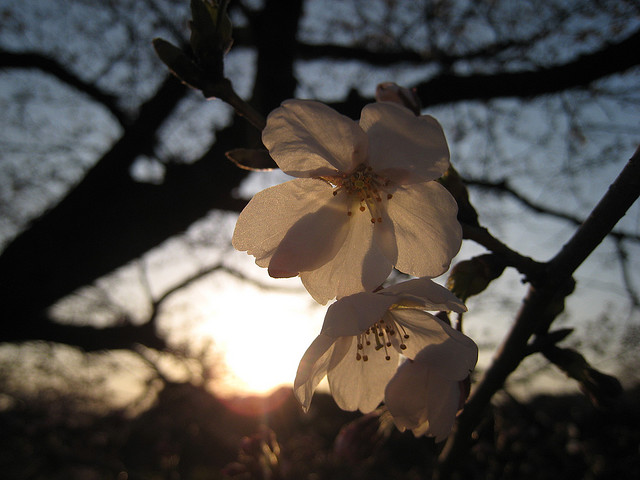
Cherry blossoms this spring in the Rhine park

Sunset on my way home last Friday

View of the Japanese garden on my way home

Short cut through the train station to avoid waiting at the lights

Down and up

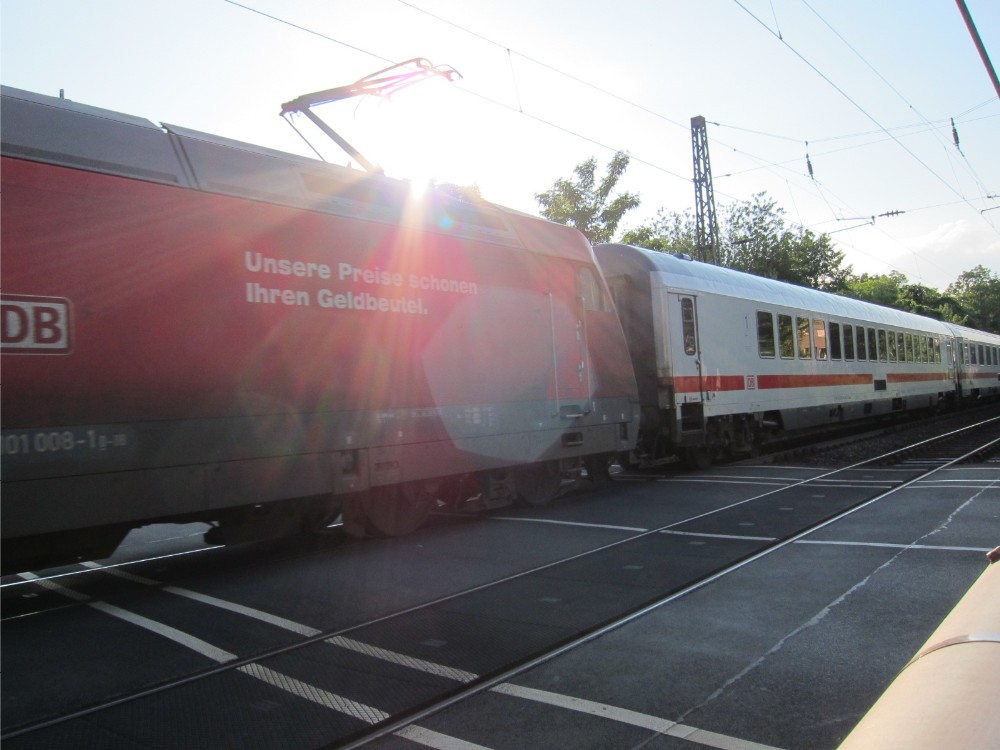
Waiting for the train to go by before crossing the tracks

My neighbourhood

The corner near where I live (for now)

Sunday, September 16, 2012

The mountains are calling and I must go


For me, spending time in the mountains is not a luxury, it is a necessity. It's important to feel unimportant, to let some air out of the ego.

I've written about this before but I think it's worth repeating: the view from the top of a mountain not just stunningly beautiful, it's also philosophically important. To stand on top of a mountain and see nothing but mountains beyond mountains all the way to the horizon is a humbling experience. You can't help but surrender yourself to the realization that you are nothing more than an insignificant speck on a tiny planet in a vast universe whose mysteries we know very little about.

This is not a bleak, cold or empty view on life. To me, surrendering to the mysteries of the universe is more fulfilling than subscribing to a religious story that claims to have all the answers. Certainty is absurd. Why not revel in uncertainty?

There is nothing more fascinating than life on earth. Our planet is the only place in the known universe where life exists, which is an amazing thing when you consider how big the universe really is. Our planet is just one of eight in orbit around our sun, which itself is only one of about 200 billion stars in our galaxy. But even our galaxy is just one of 100 billion galaxies, all joined together in an enormous web stretching out in all directions.

It's a waste to reduce all of this to a religious story and then fight over whose version of the story is better. Why can't we just marvel in the evolutionary perfection of life without ascribing some greater meaning to it?

I didn't intend for this post to go this way (I was actually going to write a straight-up post about our hiking trip in the Swiss Alps. Where we went and what it was like and all of that). It's just that everything seemed so simple in the mountains and so unnecessarily complicated back in Bonn.

We got back from the Alps the day violent protests over the anti-Islam film were making headlines. The whole thing struck me as being absurd. It boggles the mind on so many different levels. I watched the trailer on YouTube to see what the fuss was all about. And I just don't get it. The film is such an incoherent, idiotic, embarrassingly bad, low-budget mess (the whole thing looks like it was filmed in front of a green screen) that it's hard to believe anyone could take it seriously. It's not even worth responding to, let alone getting up in arms about it.

What's wrong with us? And by "us" I mean "us as a species." Why are we still whipping ourselves into a frenzy over such petty, tribal divisions? Why can't we just accept that we don't have all of the answers and that none of us have exclusive access to the truth?

Sunday, September 02, 2012

Home sweet home


I went home for the first time in more than three years. I had expected it to feel weird to be back on Canadian soil after so much time away. But everything was pretty much the same as it always was.

Still, I saw some of the same old things with fresh new eyes. Take the word "awesome," for example. A few days before I left for Toronto, a German friend asked me about the word "awesome." He wanted to know: a) what it means; b) why it's used so often in place of more descriptive and/or accurate adjectives; and c) why it's considered an appropriate response to the question, "How are you?" (I had similar conversations with a Russian friend who confessed she found the word unbearably annoying and an Albanian colleague who was shocked to receive "Awesome!" as a one-word reply to a work-related email. For the record, the email was not from me.)

I explained that awesome was just a generic word to describe varying shades of good without expressing any real degree of the goodness of the thing being described. And that the point of using the word "awesome" as a response to the question "How are you?" is to demonstrate enthusiasm and extroversion, which are prized personality traits in North America. But I also said that Americans were the true users and abusers of the word and that Canadians didn't really say it that often.

And then I went to Toronto and was proven wrong.

I don't know if my ears were attuned to the word because of all of the recent conversations about it or if people in Toronto had always used the word and I simply hadn't noticed. But as soon as I arrived at Pearson International Airport, I started to hear the word everywhere I went. I heard it on the subway. I heard it on TV. I heard it at the coffee shop. I heard it at the hair salon (the girl cutting my hair said awesome six times in one hour. I counted). I even heard it in a commercial for salad dressing ("eat awesome" was its ambiguous tagline).

The other hint that I had been away from home far too long came during an afternoon at the Canadian National Exhibition. I decided to gamble $5 at the "Guess your age" booth. The carnie sized me up. He asked me to smile, he looked deep into my eyes, he looked at my hands, he asked me what my favourite food was (Japanese) and to name my favourite movie (don't have one). He pretended to think about it for a bit and then he pronounced me 55.

Clearly, he was just giving the stuffed animals away but I was annoyed that he didn't even try to guess. What's the fun in that? So I asked him how old he really thought I was and he replied, "Um . . . 43?" I was no longer annoyed, now I was angry. (I didn't know it at the time but I would be vindicated a few days later when I stumbled across an article about the guy in the Toronto Star. He seems to consistently guess too high and is thrown off his game by tall people.)

He said it was tough to guess my age because I was tall (it's unclear why a professional age guesser would make a correlation between height and age for anyone older than 18) and because he mistook my sister for my daughter.

I used to baby-sit my two youngest sisters when I was in high school. My favourite baby-sitting game was called, "Let's pretend I'm a teenage mother and you're my children." I'd take my sisters to the mall and make them call me "mom." It used to amuse me when people thought my sisters were my daughters. Now it depresses me. So I guess that's a pretty major change.

What else did I see with fresh eyes? Well, public transit in Toronto seemed embarrassingly bad after living in Japan for three-and-a-half years. It's not convenient, it's not reliable and it never really gets you where you need to go quickly enough. Toronto is decades behind other big cities when it comes to public transit. Also, Toronto's subway system seems to attract more "interesting" passengers than other cities, such as the woman who sat beside me who smelled like she hadn't bathed in three months or the guy who sat directly behind me, clipping his fingernails the entire time.

It goes without saying that the best part of returning home was reconnecting with family and friends (although in the age of Skype and email it's difficult to lose touch).

But it was just as nice to be in an English-speaking environment. I could read menus and chat with the checkout girl and read the community listings and eavesdrop on conversations and catch up on Canadian news and read the ingredients on the cereal box and order a pizza and ask for directions. In Canada, I'm no longer an outsider living on the fringes of a world I am part of but don't really belong to. In Japan and Germany, there were days I felt completely isolated and alone. I don't feel that way in Toronto. I feel like I belong.

Growing up, there were things about Toronto I hated. I thought it was too big, too urban, too flat, too ugly. It still is all of those things but I've come to appreciate it in a way I never did before. The city hasn't changed but my perception of it has.

It's an awesome place to call home.

Tuesday, May 01, 2012

First impressions (second time around)


When you live in Japan, it's easy to forget how chatty people in other parts of the world can be. Striking up a conversation with the cashier as she scans your groceries simply isn't done in Kyoto. I've never seen anyone ask a clerk at 7-Eleven how his day is going. I've never seen a train attendant stop to chat with passengers about the weather. I've never overheard a salesgirl crack a joke with a customer. There's a distance and a quietness among strangers in Japan, rather than the jovial, overly familiar banter we're used to in the west.

So it came as a shock when I arrived in Germany and found myself surrounded by people who made small talk seem as natural as breathing. At the Frankfurt airport, I had more conversations with random strangers in 30 minutes than I'd had in three-and-a-half years in Japan.

The customs officer asked me questions about what I was doing in Germany and how long I planned to stay (technically, this conversation may have been part of his job but the tone was more chatty than interrogative). A Brazilian passenger told me about his ski trip all the way to the baggage area. At the baggage area, an airport employee took it upon himself to give me the weather forecast for the week. On the train to Bonn, the guy sitting next to me gave me an impromptu lecture on German cuisine. He described the many varieties of German bread and told me that apple juice mixed with sparkling water, not beer, was his countrymen’s beverage of choice. When the train attendant asked if we would like some chocolate, his eyes shone and he knowingly said, "Ah, German chocolate. Best chocolate in the world." His face fell when she handed me a Snickers bar (presumably not the kind of chocolate he was referring to).

But the chattiness doesn't end there. It's a constant thing. When I walk down the street, people stop me to ask for directions. When I stand in line at the grocery store, someone will turn to me and make an offhand remark about the length of the line up or last night's soccer game or their eye medication or who knows what.

This friendly banter among strangers is nice but the problem is that all of these conversations are in German and I can't speak German. Smiling, nodding and saying, "ja, ja, ja" will only get you so far. The small talk I dread the most is the kind that comes with a raised voice at the end of a sentence. A question means I have to come clean and admit that I can't speak German. I hate having to say that I can't speak German in English. It makes me feel self-conscious and rude. Whenever I say, "Sorry, I can't speak German" I'm worried the other person will interpret this as, "I will live in your country. I will work in your country. But I won't learn your language. I will speak English and so will you."

So, learning German is a priority. In the meantime, I asked a German colleague to teach me how to say, "I can't speak German" in a way that implies I want to learn German but haven't gotten around to it yet. She wrote down the following phrase: Ich spreche noch nicht gut Deutsch, konnen wir Englisch sprechen? I've memorized the words but the pronunciation (a roller-coaster of larynx-twisting sounds that gargle up from the throat to the mouth and back down again) is another story.

Aside from the chattiness and the language barrier, there are other things that are still new and exciting. Like the bike lanes on almost every street (and the cute little stoplights just for cyclists with their red, yellow and green bicycle lights). Or the fact that you can get organic food pretty much everywhere, even at the drugstore. Or the fact that my apartment has a shower inside the apartment and you don't need to feed coins into a machine to use it. Also, I now have a stove with four burners instead of one. It excites me that I can cook pasta and sauce at the same time. Cooking with a one-burner stove and no oven for three-and-a-half years was tedious, time-consuming and required a lot of creative energy. Now that I have a four-burner stove again, I have no idea how I survived without it.

On the negative side, I was surprised to discover that there is a thriving neo-Nazi scene in Germany. But here's the shocking thing: not only are there neo-Nazis but they also have parades and actually show their faces in public. I would have thought being a neo-Nazi in 2012 was the sort of thing you'd want to keep on the down low. Isn't it kind of embarrassing to march through the streets and publicly out yourself as a right-wing extremist?

There was a neo-Nazi parade in Bonn today and I went because I didn't know that neo-Nazis still existed and I wanted to see them with my own eyes (and to support to the counter demonstration, of course). However, I didn't actually get to see any neo-Nazis because there were so many anti-neo-Nazi demonstrators blocking the parade route that police put up barricades to prevent the anti-neo-Nazis from getting within 50 metres of the neo-Nazis. Thousands of people turned up to try to stop the neo-Nazi parade so that's a good thing. Here they are giving neo-Nazis the finger.


On a lighter note, I was also surprised to learn that there are cherry blossoms in Bonn. I was upset about missing the cherry blossom season in Japan. But when I arrived in Bonn, the blossoms were already here, waiting to welcome me to my new home.

Sunday, April 22, 2012

Leaving Japan


How do you condense three and a half years into a few hundred words? I could fill a book with the highs and lows of my life in Japan. But I need time to digest the experience and time isn't something I've had a lot of recently.

My last few weeks in Japan were divided between the tedious task of packing up and moving out of my apartment and the painful task of saying goodbye to friends. And then, before I knew it, I was flying to Germany and reporting for duty at work the next day. No gentle transition. No buffer. No time to process the fact that Kyoto was no longer home. My life in Japan ended as abruptly as my life in Germany began.

Just to give you an idea of how quickly everything happened, I had a meeting with one of the HR assistants on my first day at work and she asked me to provide copies of various documents, including my master's degree from Kyoto University. I had to explain that I couldn't give her a copy of my master's degree because I hadn't actually graduated yet -- I had started working before the ink on my thesis was dry. (As happy as I am to be working at the UNFCCC, missing my graduation ceremony was a bitter pill to swallow.)

From the moment the plane touched down in Frankfurt, I was caught up in the general busyness that accompanies moving to a new country -- looking for an apartment, moving into an apartment, getting a cell phone, opening a bank account, buying a bike, figuring out where everything is, adjusting to the new job, and learning a few German phrases (this is a work in progress. I haven't moved beyond "good morning" and "thank you" yet). I've been in Bonn for a month now and this is the first weekend I've finally had time to reflect on my life in Japan.

The strange thing is that I don't miss Japan. Not yet. Everything here is still too new, too exciting, too time consuming. Maybe it will hit me in a few months when I've settled into a routine. Or maybe it won't hit me at all. I've already mourned the loss of living in Japan once before. The first time I left Japan, I cried every day for a month. I had only been there for a year and I regretted my decision to leave, which is why I went back. But it was a completely different experience the second time around.

The first time I lived in Japan, I was in a rural area and embedded in the local community. It was an incredible experience but it was also a lonely and isolating one. I would swing between extreme highs and lows. I felt like I was living in the proverbial fishbowl -- everyone knew what I was doing at all hours of the day, every day. There was no privacy. Kids from school would follow me home and press their faces against my kitchen window as I cooked dinner. Old ladies would follow me around the supermarket, muttering about the food I was putting into my basket.

Living in Kyoto was nothing like living in rural Japan. It was easy to slip into the crowd and live anonymously. I spent more time with foreigners than with Japanese people. By not fully integrating into the community the way I had done in Sakawa, I created a buffer that protected me from feeling lonely and isolated. I never experienced the high highs or low lows that I did in Sakawa, but I had deeper friendships in Kyoto and was much happier as a result. You learn a lot about yourself when you live in a foreign country and sometimes these things surprise you. I always thought of myself as an introverted person but I clearly need to feel a sense of belonging to be happy. If I have a group of good friends around me, I can feel at home anywhere. The importance of feeling connected seems obvious but it took a year of solitary confinement to drive the point home.

This time around, I was ready to leave Japan. The rigidity, the inflexibility, the blind adherence to the rules, the mindless consumerism, the conservatism, the conformity, the feeling of being treated like an outsider no matter how long you’ve lived there, the expectation that you will put everything and everyone ahead of yourself and that you will sweep the mental and physical effects of doing so under the rug was starting to wear me down. But, of course, that's all objective stuff. Emotionally speaking, I'm not sure I'll ever be able to detach myself from Japan. I see Japan with open eyes. I see the good things and I see the bad things and I still love it.

The first time I left Japan, I made a list of the things I would and wouldn't miss about living there. The list still holds true today but with a few additions.

I will miss Japanese food. Not the kind of Japanese food that immediately comes to mind, like sushi or ramen. But the simple things like a square of chilled tofu topped with grated ginger and green onions. Or thin slices of gobo dressed with sesame oil. Or miso soup with mountain vegetables. Or a little box of natto for breakfast. Or even just a cup of green tea.

I will miss traveling in Japan. I have yet to visit a country that is as easy, safe or comfortable to travel in as Japan. I will miss sitting on the train watching the ramshackle houses fly by. I will miss the deserted shrines and temples on misty mountain tops. I will miss the empty hiking trails. I will miss the way people worship cherry blossoms in the spring and maple leaves in the fall. I will miss the vibrant green colour of the rice fields in the summer. I will miss hearing the mating calls of frogs that call the rice fields home. I will miss seeing the fireflies along the river on hot summer nights. I will miss hearing the scream of the cicadas. I will miss hearing the wind rush through a forest of bamboo trees. I will miss Japan at its best -- a mystical, magical place where it sometimes feels like you're living in a dream.

I want to say that Japan is no better or worse than any other country. It has its good points and its bad points. And while this is true, there is something just a little bit extra special about Japan. And that's something I will keep with me forever, even as I let go of living in Japan and move forward in Germany.

Sayonara and arigatou.

Tuesday, March 06, 2012

"You're hired!"


It's official: I got a job with the United Nations Climate Change Secretariat! I report for duty on March 19th, which gives me exactly two weeks to pack up my life in Japan and move to Germany.

I'll be an associate programme officer with the capacity-building and outreach team ("capacity-building" refers to helping developing countries build, strengthen, and improve their capacity to mitigate and adapt to climate change, while "outreach" refers to reaching out to various stakeholders, including young people and intergovernmental organizations).

But I can't get too excited yet. I still have to clear two hurdles before the job offer officially becomes official. The first hurdle is passing the UN medical exam. The exam is intense (and, under Canadian employment law, totally illegal. It took me a few days to get comfortable with the invasive nature of the questions). I have completed about half of the exam so far: chest x-ray, blood samples, urine test, eye test, blood pressure, height, weight, electrocardiogram, family history, self-evaluation, and a colorblindness test (I passed! Does this mean I get to fly a plane?). The second half includes a full physical with a doctor (including a rectal exam). The exam leaves no orifice unprobed. I can understand the necessity of the exam for UN employees working at a refugee camp or in a war zone but it seems a bit over-the-top for a desk job in Germany.

Some of the more questionable questions on the medical exam include the following: "Have you ever been absent from work for longer than one month through illness?" "Have you ever consulted a neurologist, a psychiatrist or a psychoanalyst?" "Have you ever suffered from gonorrhea?" "Do you smoke regularly?" "Are your periods regular? Are they painful? Do you have to stay in bed when they come?" "Have you gained or lost weight during the last three years?" (Seriously!?) In Canada, this would be fodder for a human rights tribunal. I trust that they're not using this information to discriminate against people who are mentally ill or HIV positive or physically disabled. I assume it's just a way to ensure workers in extreme conditions (like the aforementioned war zone) are able to endure mental and physical stress and/or to provide support and services for staff members who need it. (The UN medical exam is posted online so it's not some sort of secret. It's all very transparent and above board.)

Once I got over the initial shock, I realized it's probably a good thing that they're forcing me to take a medical exam since I rarely ever go to the doctor. If something is wrong, it will be good to catch it early. I'm just not sure how the UN defines "healthy" and if I'll measure up. If I fail the medical exam, the job offer will be withdrawn.

The second hurdle is if the German authorities refuse to issue me an entry visa. I'm pretty sure all of this will be a non-issue but the job is not a sure thing until I pass these two hurdles. So I have to temper my excitement. Plus, my general strategy in life is to always expect the worst. That way, when the worst doesn't happen, I'll always be pleasantly surprised. The way I see it, death, dismemberment, illness, heartbreak, and disappointment are always right around the corner. These things follow you around like a shadow, waiting to surprise you when you least expect it. So I live my life knowing that good health and good luck are only temporary constructs that will eventually run out. I've been on a lucky streak for a long time and I fully intend to enjoy it while it lasts.

Wednesday, February 22, 2012

PhD fail


These are the results of the PhD entrance exam. If your number is on the page, you pass. If your number is not on the page, you fail. My number is not on the page.

The reason I failed is because I didn't take the Test of English as a Foreign Language (TOEFL) in time. All prospective students are required to take the TOEFL since our graduate school is -- theoretically at least -- in English. (In reality, the majority of classes are in Japanese, the students write their reports and give presentations in Japanese, the professors give lectures in Japanese, the office sends out information in Japanese, and the mountain of paperwork we have to fill out on a regular basis is in Japanese. Ironically, the PhD results were posted in Japanese, which meant I needed to use Japanese to find out I had failed because of my English.)

The PhD exam was scored out of 400 points. The points were divided evenly between your English ability (based strictly on your TOEFL score) and the quality of your presentation. You needed 50 per cent overall to pass. The scoring system is set up in a way that someone with a good TOEFL score and a lousy presentation can pass the PhD entrance exam. On the other hand, someone with a low TOEFL score and an excellent presentation can fail the PhD entrance exam.

I got zero points for my English ability and a high score for my presentation. But because I didn't get a perfect score on my presentation, I didn't have enough points to reach the 50 per cent baseline needed to pass. Two members of my interview panel were willing to give me a perfect score on my presentation but the third professor was not. This is where things get tricky.

The two professors who were willing to bend the rules were both foreigners. They thought the TOEFL requirement for native English speakers was an embarrassingly stupid rule and they were willing to bend it. But they were both lower ranking than the third member of the panel, who was a Japanese engineering professor I had never met before. (It's a mystery as to why a civil engineer would be chosen to judge a candidate hoping to become a specialist in the field of ecological literacy.) He ended up giving me a less-than-perfect score for my presentation, which was probably the right thing to do. Objectively speaking, my presentation didn't deserve a perfect score. But by giving me a lower score, he knew I would fail the entrance exam. He wouldn't be failing me based on my suitability as a PhD candidate, he'd be failing me because I didn't take the TOEFL on time. There was no room for compassion or common sense.

Rigidity is a fact of life in Japan. This is not entirely a bad thing. Rigidity has its benefits -- trains that run on time, fantastic customer service, and an attention to detail that you just don't find anywhere else in the world. As a foreigner, you either accept the way things are done here or you don't. Ultimately, the responsibility for failing the PhD entrance exam falls on my shoulders. I should have taken the TOEFL. I've lived in Japan long enough to know that the rules are too rigid to bend.

I'm not upset about any of this. I mean, I was upset at first but I'm not anymore. In fact, I now think it's a good thing I failed. I think by leaving the TOEFL too late, I had already subconsciously decided that I didn't want to stay in Japan and do a PhD. At the same time, part of me was attracted to doing a PhD because I was passionate and excited about the research I was doing for my master's thesis and I wanted to keep it going. I was on a full scholarship that paid me to be a full-time student; it would have been easy to slide from the master's program into the PhD. But it now seems clear that the easy choice would have been the wrong choice.

With only a month to go before I graduate, I want the all of the good things about my time in Japan to be what stays with me. Despite the occasional setback, my experience here has been overwhelmingly positive. To be paid to be a full-time student is a rare privilege. It seems petty to complain about a silly rule.

Besides, the frequent ups and downs are what make life in Japan interesting. Being confronted with different ways of thinking forces you to examine your own way of thinking. Why do you see the world this way, and not that way? Why do you value this, but not that? Being an outsider allows you to see the way people have been culturally conditioned to think and act, which, in turn, allows you to see the way you have been culturally conditioned to think and act. Living in Japan has broadened my mind. And that's something that will stay with me forever. It will be difficult to leave Japan but I'm ready to move on. New opportunities and adventures await!

Sunday, February 12, 2012

Now what?


With less than a month to go before the final deadline to submit my master's thesis, people have been asking me what I plan to do after I graduate. Initially, I told them the truth: I don't know. I figured I'd figure it out after April.

But the best-laid plans often go awry, especially when your plan is to have no plan at all. Former supervisors sent job postings my way, encouraging me to apply, while my professors pressured me to stay on for a PhD. So now my problem is not a lack of choices; my problem is too many choices. I have three different options to choose from, all of them equally enticing.

Option 1: Work at the UNFCCC in Bonn

I have a job interview with the UNFCCC tomorrow night. The job title is long (Associate Programme Officer, Capacity-building and Outreach Unit, Financial, Technology and Capacity-building Programme) and the contract is short (six months). But it's a great opportunity to work on an issue I care about, learn something new, and broaden my skill set. I'm not sure what my chances of actually getting the job are; I have a feeling the competition will be fierce.

I did a four-month internship with the UNFCCC in 2010 and I took on a six-week consulting position in 2011. So I know what I'm getting into. The job will be stressful and the workload will be heavy. But the people are great, Bonn is lovely, and the work is interesting. An added bonus is that Sergey has an EU passport, which means he can live and work in Bonn. There are lots of positives. But I don't see myself being in Germany for the long haul. It's a nice place to visit but I don't want to settle down there. My heart belongs to Canada's open spaces and wild places.

Option 2: Stay at Kyoto University and do a PhD


I took the PhD entrance exam for the Graduate School of Global Environmental Studies yesterday. I'll find out on February 20th if I've been accepted and I'll find out on March 1st if my scholarship has been extended. If my scholarship isn't extended, I won't stay on for the PhD. I don't want it badly enough to pay for it.

Unfortunately, the entrance exam was a bit of a disaster. It left me feeling demoralized and questioning whether I'm really suited to do a PhD. Not only did I get ripped apart for my lack of training in quantitative research but I got zero points for my English ability, which could put my overall score near the bottom of the list.

The reason why I got zero points for English is because I didn't take the Test of English as a Foreign Language (TOEFL) in time. All prospective students are required to take the TOEFL but I figured there would be an exemption for native English speakers. Of course, I should have known rational thinking was no match against the Japanese system of institutionalized inflexibility and blind adherence to the rules, no matter how stupid or illogical the rules may be.

I'm still not sure why a native English speaker would be required to fork over $250 to take a test that measures their ability of English as a foreign language. Especially when that person grew up in an English-speaking household in an English-speaking country, attended English-speaking schools, worked as a journalist for an English-language newspaper, and worked as a communications specialist for an English-speaking NGO. (The fact that I was given zero points for my English ability is so absurd as to be humorous. But this is neither here nor there. It's my own fault for leaving the English test too late. I've lived in Japan long enough to know that the rules are too rigid to bend.)

It's stuff like this that makes me question whether I can handle another three years in Japan. But, despite the occasional setback, my experience here has been overwhelmingly positive. Loving Japan is no different than loving anything else: there are days it will irritate the hell out of you, and there are days it will make you so happy your heart feels like it will burst.

I like the idea of continuing the research I started with my master's thesis. Doing a PhD means I'll get to attend conferences and write research papers. I'll learn a lot and I'll get to set my own hours while doing it. Another three years here could be nice. Or it could be horrible.

Option 3: None of the above

If I don't get the job with the UNFCCC and if I don't pass the PhD exam or if my scholarship isn't extended, then I'm going to take six months off and just enjoy life. (Every time I tell people about Option 3, I get the same reaction: "Oooooh! I like this option the best!")

I'll go back to Canada in April and spend a month with my family in Toronto. Then I'll cross the country, visiting my sisters in Halifax, Yellowknife and Nelson. I'll catch up with friends in Vancouver, Montreal and St. John's. Finally, I'll head to Bulgaria for three months to spend time with Sergey. If our relationship is still going strong after that, we'll probably move to Canada together. If not, I'll be heading home alone. No job, no boyfriend, and no regrets.

It scares me to think that I will have a definitive answer to the question "what are going to do after you graduate?" within a few weeks. I don't know why but knowing what I'm going to do after I graduate is more terrifying than not knowing what I'm going to do.

Sunday, December 18, 2011

Deconstructing Durban


I spent the past two weeks in Durban, South Africa, at the United Nations climate change conference. I think I have recovered from the sleep deprivation, the over-caffination and the general frustration enough to put my thoughts into words.

I want to talk about what it was like to be at the conference. And I want to talk about the youth delegates, whose energy, enthusiasm and optimism blew my mind on a daily basis. But, before I do that, I want to talk about the outcome of the conference. To get the bad news out of the way first.

Durban was an incredibly complex and difficult meeting. In the end, all we got was a vague document called the Durban Platform for Enhanced Action. It's not a protocol or a mandate, just a "platform." It's too soon to tell if that's a good thing or a bad thing. If governments decide they want to raise the level of ambition on climate change, the Durban Platform can be a tool to set us on course. We now have an agreement to negotiate an "instrument" with "legal force." Governments can, theoretically, design the new instrument to match up with the deep emission cuts the IPCC indicates are necessary to avoid the worst consequences of climate change. The negotiations on the new instrument will determine if we are serious about solving climate change or not. So it's difficult to label Durban a success or a failure; it's what happens next that really matters.

That's the big question, what happens next? Will new negotiations actually result in real emission reductions or will it be too little, too late?

It's easy to feel pessimistic about international negotiations on climate change. Each meeting seems to follow the same pattern: all talk, no action. World governments have been talking about climate change for 20 years with very little progress. Trying to get 194 countries to move together in the same direction on climate change feels less like building consensus and more like herding cats.

Complicating matters is the fact that climate change comes with a time limit and the window to stabilize global temperatures is closing. The International Energy Agency has shown that CO2 emissions in 2010 were the highest on record; and they're still rising. Every year we don't deal with it, the problem just gets worse. And at a certain point, it will be too late to fix it. There will be too many emissions in the atmosphere and no way back to a world that isn't buffeted by uncontrollable, catastrophic climate change.

Scientists have been telling us increases in global temperatures must be kept to no more than two degrees Celsius above pre-industrial levels. In order to limit temperature rise to two degrees, the IPCC warns that global emissions have to peak by 2015 and then drop to 50 per cent below 1990 levels by 2050.

But the latest science from the Tyndall Centre for Climate Change Research suggests that two degrees is no longer the threshold between "acceptable" and "dangerous" risks but between "dangerous" and "very dangerous" climate change. Scientists there are now looking at 1.5 degrees as a safer target. That means cutting global emissions at least 85 per cent below 1990 levels by 2050.

We are nowhere near that. The Kyoto Protocol contains targets that are far too small to achieve any of those goals. Under the Kyoto Protocol, developed countries are supposed to cut their greenhouse gas emissions a mere 5.2 per cent below 1990 levels by 2012. That's not going to happen.

Part of the problem is that negotiations are complicated by fundamental differences of positions, which have yet to be resolved. Countries will have to find a way to work through several key differences, including differences of historical responsibility, differences in development and differences in geographic vulnerability to climate change. International cooperation on deeper emission cuts will be impossible unless these differences can be resolved. Compounding the problem is a lack of political will to do what is necessary to tackle climate change.

Which is why Durban -- just like each and every climate conference preceding it for the past two decades -- was an incredibly complex and difficult meeting.

A snapshot of the Durban climate conference


It's worth mentioning what it's actually like to be at one of these United Nations climate change conferences. The scale of these meetings is so big that critics often deride them as a traveling circus. (I don't like the negative connotation but it's not an entirely inaccurate description.)

Since 1995, representatives of countries from around the world have gathered at the annual Conference of the Parties to hammer out the details of international action on climate change. For two weeks each year, thousands of negotiators, politicians, heads of state, journalists, celebrities, business leaders, academics, youth activists and environmentalists converge in a frenzy of activity. Because there are so many high-profile people in one place, security is always a big concern. Passing your bag through an X-ray machine and walking through a metal detector become as much a part of your daily routine as brushing your teeth.

The security checkpoints, scanners, X-ray machines, fences and road closures make you feel as if you are entering a gigantic hermetically sealed bubble when you walk through the conference doors. And, in a way, you are. You are entering a universe unto itself with a language unto itself. Everyone at the conference speaks in abbreviations: CDM, JI, REDD, SBSTA, SBI, AWG-KP, AWG-LCA. The numbingly dull list goes on and on (and we wonder why we're not winning the hearts and minds of the general public).

I would hate to be one of the thousands of journalists covering the conference. The whole thing is so confusing and difficult to understand that I wouldn't know where to begin. How they manage to distill it down to a succinct sound bite is beyond me.

That's not to say the journalists don't struggle. I saw a journalist crying in the women's washroom during the first week of the conference.

"It's really hard to know what to write or how to put it all together," she sobbed.

It's too bad Bill Clinton turned the expression into a cliche because there's no better way to describe it: I felt her pain.

The conference was held inside the sprawling Durban International Convention Centre, which was unremarkable as far as convention centres go. Still, Durban wins points for its creative space-saving techniques. The underground parking garage was transformed into makeshift offices for the UNFCCC, as well as the American, British and Canadian delegations. It was an airless, windowless, oil-stained, concrete wasteland.


These conferences are what I imagine being on a cruise ship is like, minus the onboard entertainment (unless you count as entertainment the small contingent of oddballs that always turns up at these conferences -- such as the woman registered as "Supreme Master" or his highness Lord Monckton, who showed up in Durban to stop the Marxists’ wet dream of global totalitarian dictatorship).

Sitting in on international climate negotiations requires a strong stomach, endless reserves of patience and a suppressed gag reflex. In Cancun last year, I watched as negotiations on a draft text to enhance public awareness and education on climate change began with 45 minutes of bickering by countries over the wording of one sentence in the opening paragraph. And this was one of the least nasty, least confrontational negotiating sessions.

It's no secret that certain countries come to the negotiating table year after year to obstruct rather than push for progress. These thinly veiled attempts to kill the Kyoto Protocol have brought negotiations to a virtual standstill. The pace of international climate change talks is now so grindingly slow it's no wonder almost nothing gets accomplished. The Kyoto Protocol is still alive but it's on life support.

And now for the good news


If we want to shift the level of ambition and political will that countries bring to the international negotiating table, we need to ramp up public concern on climate change. Without public pressure for strong action, countries will be able to continue to push for weak targets at international climate negotiations. Ministers will be able to return home from these meetings and ignore the problem until the next summit. Without public support for immediate action, international negotiations will continue to go nowhere and emissions will continue to rise.

Building popular demand for fundamental changes requires all of us to become involved. The good news is that things are already changing, with NGOs, schools and young people leading the way. I met many people in Durban working hard to make a difference. But the ones who impressed me the most were the young people.

The UNFCCC hired me to help with youth-related activities in Durban. My job was to make sure the youth delegates were able to participate in the process as fully as possible. We arranged meetings for them with high-level negotiators. We organized four slots a day for mini-side events. We gave them booths, an office, a meeting room, space to protest, logistical support, and the ability to intervene during negotiating sessions. To its credit, the UNFCCC truly understands the importance of giving youth a voice at these conferences. After all, it's their future that is up for negotiation.

The youth delegates blew my mind on a daily basis. They were an endless source of optimism, hope, positive energy and creativity -- essential ingredients in the shift toward a more sustainable future.
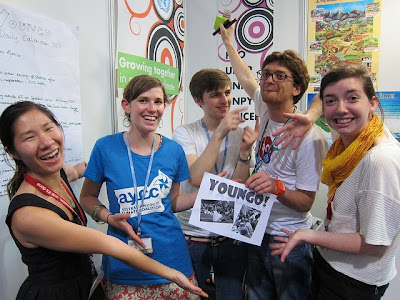


It was a good conference for young people. They got more media coverage than I've ever seen them get before. Three stories stood out for me.

The first was the six young Canadians who stood up during Environment Minister Peter Kent's address at the main plenary and turned their backs on him.

The second was the young woman who interrupted the speech by the U.S. chief negotiator Todd Stern. Security officers eventually led her out of the room but not before her plea for action was met with long, sustained applause from the room full of delegates and negotiators.

The third was the huge protest that went on for hours inside the convention centre on the last day of the conference. Young people refused to move until they got a fair, ambitious and legally binding agreement on climate change. They didn't get what they wanted. But, still, it was an exciting thing to see. You got the sense that they are the front wave of a much bigger movement back home.


Every young person in Durban was there because they care passionately about climate change. Some came to share their views with delegates, others to raise awareness about the work of their organizations through side events.

The UK Youth Climate Coalition, for example, worked hard to let the outside world know what was going on inside the climate talks. They filmed, edited and produced several short videos that they uploaded to YouTube while in Durban.

My personal favourite Shakira's Waka Waka Comes to Durban features young people singing and dancing to the theme song of the FIFA World Cup in South Africa. Because the climate conference was also being held in South Africa, the youth delegates decided to make Shakira's Waka Waka their official song too.

I hate to single out individuals because there was not one youth delegate who didn't impress me. But I think it's important to give a few concrete examples of the kind of work young people are doing.

Like Danae, who is working to engage young people on climate solutions in Mexico. Her project to improve alliances among young people, governments and NGOs won a national award, which is how she ended up in Durban.

Or Anton, a 17-year-old high school student from Germany, who wrote a policy paper on sustainable transportation, which he presented at a mini-side event in Durban. What was I doing when I was 17? Getting drunk, listening to Led Zeppelin, failing math? I had neither the motivation nor the intellectual capability to write policy papers at 17. At this rate, Anton is going to be the Chancellor of Germany by the time he's my age.

Or Esther, who developed a toolkit on climate change for young people in her home country of Nigeria. Her work took her to rural schools, where she helped set up climate change clubs. She also runs what she describes as the best blog in Africa.
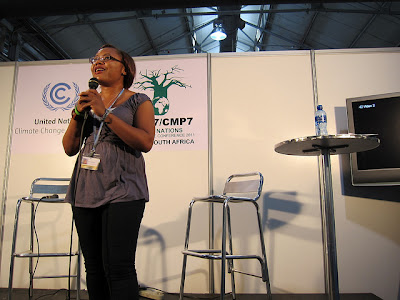

Or the group of kids from South Africa who are leaders of their school's climate change clubs. They spoke about their school gardens, their recycling projects, and their efforts to raise money to install solar panels on their school roofs.


Or Jordan and Curtis, cousins from Nunavut in their early 20s. They came to Durban with a strong message for world leaders: climate change is devastating their northern home.

Jordan and Curtis spoke about how the snow is arriving later and melting sooner in Canada's far north. They also spoke about how melting Arctic sea ice is hurting polar bears, which rely on ice floes for shelter, hunting and breeding. As a result, hungry polar bears have been turning up at the town's garbage dumps in search of food.

The young men have spent time documenting the effects of climate change on their community through films and blogs. Their work focuses on Inuit Qaujimajatuqangit (the traditional knowledge) of Elders. In preparation for the UN conference, Jordan created a film titled Experiences of Climate Change from Inuit Elders.

"I have a grandpa who likes to talk a lot," Curtis said. "We're not scientists but we know our land."


The examples go on and on. If I listed all of the brilliant work young people are doing to draw attention to climate change, I could fill a book. If these are our future leaders, the world is in good hands.

As for me, something wonderful happened on the last day of the conference. I had helped organize a high-level briefing for youth with Christiana Figueres, the head of the UNFCCC. More than 150 young people came out to hear Christiana talk about the status of negotiations and answer their questions. I was up on stage, moderating the event. We were running out of time but Christiana announced that she would take one last question. Neva, of the UK Youth Climate Coalition, was the first person whose arm shot up in the air. I pointed to Neva and she leaned forward to speak into the microphone. She explained that she wanted to make a comment rather than ask a question.

"On behalf of the youth, I just want to thank Sarah for all of the great work she's been doing. We appreciate her efforts." And then the youth delegates raised their hands in the air and wiggled their fingers in silent applause (clapping is so last century). I was so touched I almost started crying.

I gave Neva a hug afterward and told her that her comment was like a knife through my heart (in a good way). All of it, all of the sleep deprivation, the over-caffination, the frustration, all of it made worthwhile by one touching comment. It was nice to be appreciated but it was even better to have spent those two weeks giving love to the youth and getting love back. It was a moment that will stay with me forever.

Toward the end of the conference, many of the youth said they felt like they had been riding an emotional roller coaster. They vacillated between feeling inspired by the possibility of a better world and frustrated with the low level of political will to make that happen. Still, they realize a lot of the work happens between conferences, that climate change is not something the world tackles only once a year for two weeks.

Climate change is urgent but urgency does not mean panic. It means continuous, patient action to change the world, which is exactly what these wonderful young people are working hard to do. And that should give all of us hope.

You can check out the rest of the photos from Durban on my flickr page.

Monday, November 21, 2011

Forward


Halfway through writing my master's thesis I was struck by a profound realization: I was not writing a master's thesis, I was writing a love story. I was writing about things that mattered deeply to me -- love of nature, love of the universe, love of place, love of community. I'm not sure if there's room for the word "love" in a master's thesis about the current environmental crisis but love is what underpins this paper. It's about the need to touch people's hearts, not just their minds.

I had originally planned to look at how to communicate climate change in a way that motivates people to act. But my heart wasn't really in it. I had no clear hypothesis. Just a vague idea that the way we communicate about climate change wasn't working.

Everything changed six months ago when I took Professor Singer's academic writing class. She assigned us a 3,000-word paper with the freedom to write about anything we wanted to -- as long as the paper was backed by research. At that point, I was tired of writing dry, pedantic reports on climate change. I wanted to write something from the heart; I wanted to write about my love affair with the mountain behind my home. Prof. Singer could have rejected my idea but, instead, she encouraged it. And so I started to go deeper into my mountain.

But it wasn't enough just to research the mountain, I also needed to climb it. To breathe its forest-filtered air. To hear its birds sing overhead. To sink into its mud underfoot. To reach its summit and to see nothing but mountains beyond mountains all the way to the horizon.

The reward for all that effort was not to feel as though I had conquered the thing but to feel humbled by it -- to surrender myself to the realization that we are nothing more than an insignificant speck on a tiny planet in a vast universe whose mysteries we know very little about. But to also feel, with unwavering certainty, that we are connected to everything and everyone.

The more time I spent on the mountain, the more the focus of my paper started to shift. I was no longer writing about the mountain, I was writing about connectedness. As I got deeper into researching this ethos of connectedness, I came across a term I had never heard before: ecological literacy. I learned ecological literacy is about knowing the story of who we are and where we come from. It's about understanding that we are part of -- not apart from the natural world. That we are a species that is utterly dependent on healthy ecosystems for the food we eat, the air we breathe, and the water we drink.

I started to see the ethos of separation as the root cause of environmental problems. Dualistic thinking divided a harmonious ecosystem into separate parts -- human and non-human. It placed us as rulers of an earth whose natural resources existed solely for our benefit.

Thinking of ourselves as being at the top of some imaginary pyramid, with everything else beneath us and of lesser value, is a scientifically incorrect and outdated worldview. It was created at a time when we didn't understand the consequences of our actions. During the Industrial Revolution, we didn't know burning fossil fuels would cause climate change. Ecoliteracy is about the shift to a way of thinking that reflects the scientific reality of the world we live in. It's about recognizing that the earth is an intricate system of relationships that we are part of. It's about moving away from an ethos of separateness toward an ethos of relatedness.

Nature does not belong to us; we belong to nature. That is ecoliteracy.

Without this basic ecological understanding, it's easy to believe the myth that we have absolute control. This delusion can have tragic consequences, as all of us in Japan now know. The Fukushima nuclear disaster exposed the human arrogance that leads us to think we can somehow "outsmart" nature by building nuclear power plants as if they were unsinkable ships impervious to the rumblings of the earth and the movements of the ocean.

Stumbling upon ecoliteracy triggered an epiphany. I immediately knew this is what my master's thesis needed to be about. I asked my supervisor, Professor Gannon, if I could scrap my original thesis plan and start from scratch. She agreed, even though it meant I would have to scramble to submit everything on time. The result is a thesis that is both the culmination of my life and the beginning of its newest chapter.

Becoming ecoliterate


David Orr writes that most people who consider themselves environmentalists tend to share three things in common: 1) They have had experience in nature at an early age; 2) They have had an older mentor or family member who shared a love of the natural world; 3) They later read some seminal book that said clearly what they were feeling deeply but could not express well.

My own story follows the same three steps. I grew up in Canada, born to parents who thought it important to instil a love of nature in their children. Every summer, we rented a cottage on the shores of Georgian Bay where my grandfather was born. Every morning, my dad made us comb the beach for empty beer bottles. When my dad would dig armpit-deep through the public garbage cans, I went silent with embarrassment. But I endured these humiliations for profit-related reasons. The more bottles we collected, the more money we got. Every night, after dinner, we would walk to the local convenience store to spend our earnings on candy. The thing I liked most about these walks was stopping at the pond along the way. The pond was filled with thousands of tadpoles and to me there was nothing more magical than watching a mass of squirming black dots grow into fish-like creatures that would sprout legs and eventually hop out of the pond as frogs. My parents set out to instil a sense of wonder in me and it worked.

My parents nurtured my love of the natural world but it was David Suzuki who made me care about it. I was introduced to David Suzuki during a high school biology class taught by Mr. Ranucci, the man of my teenaged dreams. I sat in the middle seat in the front row of his Grade 10 biology class. They say there are bats sensitive enough to detect the movement of a moth flexing its wings as it sits on a leaf. That was the way I listened to Mr. Ranucci -- like a bat closing in on a moth.

One day, Mr. Ranucci made us read an essay written by David Suzuki about the state of the environment. That essay changed my life. It crystallized my feelings about the natural world and put them into words. I don't remember exactly what he wrote but I remember feeling like I had been hit by lightning.

I decided I wanted to become a scientist like David Suzuki. The only problem was I kept failing math and chemistry. So I became a journalist instead. I was good at it but I hated it. I couldn't detach myself emotionally from the stories I was covering. And I was shy. I never got comfortable with approaching random people and asking them for interviews. I lasted three years as a journalist until I left for a place that was a better fit for a thin-skinned introvert.

I don't believe in fate but if I did, I'd say there was something else at work when I landed a job at the David Suzuki Foundation. I spent the next seven years working side-by-side with the man who changed my life when I was a teenager. Call it kismet.

However, it was far from paradise. The work often felt Sisyphean in nature. Just like rolling a boulder up a hill, it seemed like we were constantly offering solutions to environmental problems that fell on deaf ears. The struggle to turn policy into legislation, only to be defeated again and again, was an exercise in frustration. Caught up in daily work and deadlines, it was difficult to know if we were really making a difference. There was little time left over to step back and critically evaluate what we were doing well and what we were failing to do well.

When I applied to do a master's degree at Kyoto University, I wanted to look at how to communicate climate change in a way that motivates people to act. That, in turn, led to an internship with the United Nations Framework Convention on Climate Change (UNFCCC) last year. I spent four months at the UNFCCC's office in Germany, where I compiled information for a report on what countries have (but mostly haven't) done to increase public awareness and education on climate change.

It was disappointing to see the low priority given to public awareness and education on climate change in many countries. Public support for measures to fight climate change is critical to their success. Without public pressure for strong action, countries will be able to continue to push for weak targets during international climate negotiations. Ministers will be able to continue to return home from these meetings and ignore the problem until the next summit.

It's easy to blame political leaders for the failure to reduce greenhouse gas emissions. But the problem goes deeper than that -- there is very little being done to address the root cause of climate change. And while it's true that climate change is caused by increased concentrations of greenhouse gases in the atmosphere, that's only part of the story. The climate crisis is also a crisis of worldview.

We don't live in an infinite world and yet we act as if we do. We act as if the ocean will never run out of fish or as if the ground will never run out of oil. During the past 250 years, human beings have altered the planet more rapidly than any other period in history. We have consumed resources faster than they can regenerate. We have driven thousands of plants and animals to extinction. The science is clear: a major shift in our consumption and production patterns is needed in order to live within the constraints of the natural systems that support us.

We need a way of thinking that reflects the scientific reality of the world we live in. We need to understand the natural systems that make life on earth possible and to live accordingly. We need to become ecoliterate.

But what does becoming ecoliterate mean in practical terms? I spent two weeks at Schumacher College this fall in an attempt to answer that question. Satish Kumar, the director of the college, explained that ecoliteracy is about acquiring basic ecological knowledge, and then putting that knowledge into practice. I asked him how to move people toward a more ecoliterate worldview. How do you start a groundswell? He said most social movements tend to share four things in common:

1. Action. If you want to influence other people, you need to back up your words with action. It's not about being dogmatic or demanding. It's about being the change you want to see in the world.

2. Communication. Share your ideas. If 10 people share their idea with 10 other people, they will reach 100 people. If 100 people share their idea with 10 other people, they will reach 1,000 people. If 1,000 people share their idea with 10 other people, they will reach 10,000 people. Ideas can spread exponentially, so start spreading them.

3. Organization. Slavery in America ended because people organized. The Berlin Wall came down because people organized. The Arab Spring spread across the Middle East because people organized. People need to come together to make their voices heard.

4. Long-term commitment. Urgency does not mean panic. It means continuous, patient action to change the world.

And while I agree with these steps in theory, putting them into practice is much more difficult. Working on environmental issues tends to leave me vacillating between idealism and cynicism. Seeing ecoliteracy in action at Schumacher College inspires me; seeing the lack of political will at international climate negotiations depresses me. But I recognize the importance of staying away from the extreme end of idealism (the naive and infantile kind of thinking that presumes people are inherently good or will choose to do the right thing) and the extreme end of cynicism (the negative and defeatist kind of thinking that constantly says "that's unrealistic").

Hope is the safe middle-ground between the two extremes. History gives me hope because history proves that worldviews can shift and people can change. Science has given us the power to destroy the environment but it has also given us the knowledge to understand the consequences of doing so. We're living at exactly the right moment in time. We are aware of the consequences of our actions. We can turn things around.

The earth is our only home. But more than that, it is the only place in the known universe where life exists, which is an amazing thing when you consider how big the universe really is. Our planet is just one of eight in orbit around our sun, which itself is only one of about 200 billion stars in our galaxy. But even our galaxy is just one of 100 billion galaxies, all joined together in an enormous web stretching out in all directions. It puts our tiny planet into perspective. In the vastness of the universe, life on earth is special and rare and worth protecting.

In the end, that's what this thesis is about. It's about everything that matters deeply to me -- love of nature, love of the universe, love of place, love of community. It's about moving beyond being a passive receiver of environmental knowledge, toward a deeper understanding of ecology and igniting the passion for change.

It is not just a master's thesis; it is a love story.


Note: I wrote this as a foreword to my master's thesis. I thought it was important to explain why I was writing this thesis and what it means to me. But, fundamentally, I wrote it for myself. I wanted to tell the story of how I got to this point. I'm not sure if my supervisor will allow me to include it in the final draft, which is why I decided to post it here.