Showing posts with label Bike love. Show all posts

Thursday, May 08, 2014

The mystery of the Japanese town populated by life-size dolls has finally been solved


Five years ago, I ventured out on a week-long solo bike trip across a small chunk of rural Japan. I wrote about riding through ghost towns devoid of people but full of life-size dolls (here and here).

From a distance, I mistook the dolls for people since they were doing the usual things that people do. They were working in the fields, fixing cars, waiting at the bus stop, sitting in chairs, fishing in canals, puttering in gardens and sleeping on park benches. Except they weren't moving. It was only when I got closer that I realized they weren't people at all. In fact, there were no people anywhere. Just dozens of dolls. I was alone in a town swallowed by mountains and populated by life-size dolls. It was deeply unsettling. I took a few photos and didn't linger for long.

At the time, I didn't know who put the dolls there or what they meant. But now, five years later, the mystery of the Japanese doll town has finally been solved.

Someone by the name of Fritz Schumann made this short documentary about the woman responsible for creating the doll town. The story it tells is beautiful and sad and totally worth watching.


And just for fun, here are a few more photos from my own (brief) trip to this town five years ago.


Sunday, July 01, 2012

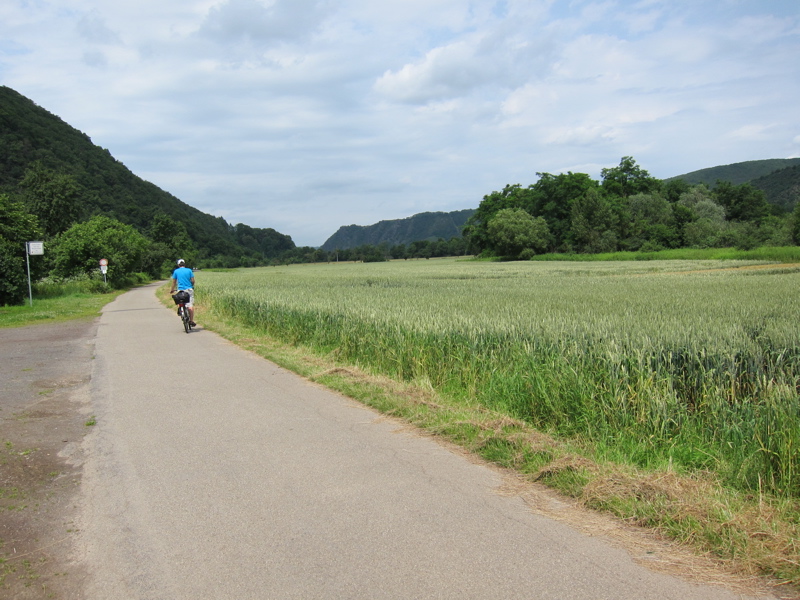
Bonn to Koblenz by bike


To me, a city's livability is directly related to its bikeablity. The easier it is to get in, out and around a city by bicycle, the happier I am to live there.

Bonn may not be the world's most dynamic city but what it lacks in excitement it makes up for in bikeability. The city is littered with bike lanes, bike paths, bike trails, bike stoplights, bike stores, bike rental shops, bike parking spaces, bike signs, bike routes and bike maps. (Unfortunately, being a paradise for cyclists also makes Bonn a paradise for thieves. Stories about stolen bikes are as ubiquitous as sauerkraut and sausages.)

Not only is it easy and safe to get around Bonn by bike, it's easy to ride from Bonn to other cities and towns in Germany (or to neighbouring countries, for that matter). Pretty much every region in Germany has a network of signposted bike routes. The country is criss-crossed by more than 200 long-distance trails covering 70,000 km, which makes it a perfect place for bike touring.

One of the first things I did when I arrived in Bonn was buy a bike. I've been itching to get out and do some cycle touring on the weekends but the weather wasn't cooperating. So when the forecast finally called for blue skies and warm temperatures yesterday, I decided to test out some of Germany's trails with a short 65 km ride down the Rhine from Bonn to Koblenz.


The nice thing about the ride was that it was almost entirely car-free. The majority of the route was down a bike path beside the Rhine, with a few back roads, forest trails and city streets thrown in for fun. The whole thing was well signposted with markers every few kilometres.


The best thing about the ride was that every 10 km or so, the path would cut through a small town on the banks of the Rhine, which meant plenty of opportunities for cake and coffee breaks. It took us more than seven hours to ride the 65 km to Koblenz. Of that, only four hours were spent in the saddle. The rest of the time was spent eating, relaxing and taking photos.


We arrived in Koblenz with enough energy to do some sightseeing before dinner. And, of course, no German bike adventure would be complete without capping it off with a tall, cold, German beer.


Heading back to Bonn was easy because bikes can be taken on trains in Germany. You can always ride one way and take public transport back. It's just one more layer of bikeability, which makes me happy to live here.


Saturday, May 30, 2009

Kochi to Kyoto by bicycle: Day 6


Day 6
May 5, 2009
Start: Nara
Finish: Kyoto
Distance: 70 km
Departed: 6:30 a.m.
Arrived: 12:00 p.m.

A few days back, at a stop somewhere in Shikoku, I read a very juicy rumor on the internet. Apparently, there is a riverside bike path that goes all the way from Nara to Kyoto. Fifty kilometres of car-free cycling. It would be the perfect way to end the trip.

The only problem was I couldn't find anyone in Nara who was able to confirm the rumor. No one had heard of the bike path. Not the woman working at the youth hostel. Not the senior citizens sharing my dorm room. Not the boy stocking shelves at the grocery store. Nope, never heard of it, they all said.

I looked at four different maps. The bike path wasn't marked on any of them. But I was determined to find it. Anything to avoid riding along crowded, congested Route 24 -- the main road linking Nara with Kyoto.

All I knew was that the bike path ran alongside a river (don't ask me which river, the internet only hinted at "a river") heading north all the way to Kyoto. I figured if I crossed every river in town, I would eventually find it.

It was a half-baked plan and I'm not sure I would have ever found the bike path had I actually followed through with it. Luckily, I crossed paths with a group of Japanese cyclists immediately after setting off in the morning.

They were stopped at a red light and I figured if anyone in Nara knew where the bike path was, these people would. So I asked them if they knew the way.

Fortunately, they had heard of the bike path. Unfortunately, they didn't know exactly where it was.

The bike path doesn't technically start in Nara, they told me. You have to ride about 10 kilometres north to the town of Kizu first. And then you can get on it from there. But they didn't know where it was exactly. They couldn't be any more specific than "somewhere in Kizu."

Before I could thank them and figure out how to get to Kizu on my own, they offered to lead me there. Once again, I was rescued by the kindness of strangers. (The kindness of strangers was a recurring theme of the trip. There wasn't a single day where someone didn't go out of their way to help me. I swear I must owe, like, half the population of Japan a drink by now.)

The three spandex-clad roadies set off with me in tow. They were going about 30 km an hour and I was working hard to keep up with them.


After we reached the town of Kizu, they told me if I kept going straight, I would probably hit the river. Probably. Maybe. They weren't entirely sure.

I thanked them and we went our separate ways. They had gotten me to the town of Kizu but they had left me nowhere near the river. I simply couldn't find it. I went straight and backtracked a couple of times but there was no river in sight.

There was, however, a 7-Eleven in sight so I pulled in to ask for directions. (Asking people who work at 7-Eleven for directions was also a recurring theme of the trip. Even if they don't really know where you're trying to go they will not give up until they are sure they have pointed you in the right direction. They will pull out maps, make phone calls, consult with management. Whatever it takes. No matter how long it takes. It's just the way things are done in Japan. This extreme attention to detail and dogged determination to find the right answer can be annoying when you are in a hurry but it's a lifesaver when you're truly lost.)

Fortunately, the woman working at the 7-Eleven knew where the bike path was. Unfortunately, she refused to tell me how to get there.

This happens quite a lot in Japan. You'll ask someone a question (for example, you approach a random stranger on the street, point to your map and say, "I'm trying to walk to this restaurant. Do I turn left or right here?"). But instead of giving you an answer, they'll give you advice ("You shouldn't walk there. It's better if you take the subway."). I know they mean well but all of the unsolicited advice drives me crazy. Just answer the question!

Anyway, the woman working at the 7-Eleven told me she knew where the bike path was. But she refused to tell me how to get there.

"You shouldn't take the bike path to Kyoto," she said. "It's too far. It's better if you take Route 24."

I told her I didn't mind the extra distance.

"Well, it's better to take Route 24. It's faster."

I told her I wasn't in a rush.

"Well, it's a long way to Kyoto and you might get tired if you try to ride there on the bike path," she said.

I told her I would probably be fine.

"Well, you might get hungry and you won't be able to find a convenience store on the bike path."

Oh, god. This wasn't going to end. Please. Just. Answer. The. Question.

Sensing that I wasn't going to give up the bike path in favour of crowded, congested Route 24, she finally caved and told me where it was.

Her directions were bang-on and I found the trail easily. The only problem was I wasn't sure if I should turn left or right when I got to the river. I asked a guy who was out walking his dog for help.

"You're going to Kyoto?" he said. "You should take the highway. It's much shorter."

Here we go again.

Why do so many people in Japan feel compelled to offer advice instead of giving a direct answer to a direct question? And why do they always think the path of least resistance is the best option? It's a cultural divide I'm not sure I'll ever be able to cross.

I had to repeat the question a few more times before the guy gave me a straight answer (turn left).

I'm glad I didn't give up on my quest to find the bike path. It was a wonderful way to end the trip. Fifty kilometres of car-free cycling through a lovely river valley.


It was also good practice for my Japanese. Not only did I have to speak Japanese throughout the trip, but I had to read a lot of Japanese signs and maps too. I still have a long, long way to go before I can master the language but I can actually read this sign. It says the left side is a walking path and the right side is for bicycles. Of course, any idiot can guess that's what it says but I could actually read it. It was kind of exciting.


Other signs were a bit more difficult to understand. Apparently, there is an evil, raging river somewhere behind this sign. (Also, who knew rogue waves wore braces?)


You can put flowers on an outhouse but it's still an outhouse.


I had to leave the path after reaching the outskirts Kyoto as it started to veer sharply west and I needed to go east. Fifteen kilometres of city cycling later, I was finally home.


It took six days to ride more than 500 kilometres across Shikoku and up through southwestern Honshu. But I did it. And I did it all by myself.

I know it may not seem like a big deal, but, for me, it was. It was an accomplishment I was hugely proud of. More importantly, it was a reminder of something I needed reminding about -- if you change your beliefs about your limits, your limits themselves change.

Before I left, I wasn't entirely convinced I was physically capable of doing such an epic bike trip. And I was a little nervous about doing it alone. But I love a challenge. I like pushing myself physically and testing myself mentally. I need to test my limits every now and then. The more I test them, the more they disappear. Impossibilities become possibilities. It's a good feeling, this feeling of limitlessness.

But it's not nearly as good as being on a bike with nothing to do all day but ride.

Previous day | Photos

Thursday, May 21, 2009

Kochi to Kyoto by bicycle: Day 5


Day 5
May 4, 2009
Start: Gojo
Finish: Nara
Distance: 70 km
Departed: 8 a.m.
Arrived: 2 p.m.

Nothing much happened on Day 5 of my cycling trip. This is probably not the best way to start a story. But a completely uneventful and unremarkable day is all I wanted after a very stressful Day 4.

I was worried my cycling adventure was turning into a cycling misadventure. So it was a huge relief that nothing much happened on Day 5.

I had originally planned to cycle from Kochi to Kyoto in five days, which meant today was supposed to be my last day. I was going to ride from Gojo straight to Kyoto. Gojo is about 110 kilometres directly south of Kyoto, and Route 24 would have taken me all the way there.

But Route 24 was a busy, congested road and I wanted to spend as little time on it as possible. After studying the map, I figured I could head east for about 20 km and then loop northwest to Nara along quiet country roads. From Nara, I could head west along the river and then loop northeast into Kyoto.

Detouring around Route 24 would add about 50 kilometres to the trip. Not a huge distance but enough to make me want to break the last day up into two days. Two short days of riding would be much more enjoyable than one tediously long day. Besides, I wasn't in any rush to get back to Kyoto. There were still two national holidays left before Golden Week was over.

Nara, the ancient capital of Japan, is halfway between Gojo and Kyoto and a logical stopping point. I put my name on the waiting list at the Nara Youth Hostel, which was booked solid when I called. Luckily a last-minute cancellation came up. And that was how a five-day trip turned into a six-day trip.

Splitting the last day into two days meant I could take my time as I detoured around the main road. There was a lot of lovely countryside and empty roads on the way to Nara.


Why so sad Mr. Snowman?


Inevitably, I had to do some riding on the main road to get into Nara. There wasn't much in the way of scenery. Unless you count soul-deadening suburban sprawl as scenery.


I think the sign in the following photo is grammatically incorrect.


Someone forgot to put an "s" on the end of "liquor." Foods and liquors (sorry, FOODS & LIQUORS) has a much nicer ring to it, don't you think?

Speaking of foods and liquors, I don't know what I would have done without 7-Eleven. Oh thank heaven for 7-Eleven. Seriously. I'm not making a cheap joke here. 7-Eleven was a lifesaver. I could always count on 7-Eleven for tasty food, cold drinks, clean bathrooms and help with directions.

No matter where I was, I was never far from a 7-Eleven. (Interesting fact: Japan has more 7-Eleven stores than any other country in the world. There are almost twice as many 7-Elevens in Japan than in America.)

Every 7-Eleven in Japan has the same slogan. Or maybe it's not a slogan exactly. But directly underneath every 7-Eleven sign there are always the same three words written in Japanese.


The first word 酒 is alcohol.

The second word たばこ is cigarettes.

The third word 銀行 is bank. (Put ATM behind the character for bank and you get, um, bank ATM?)

So, basically, the Japanese 7-Eleven slogan can be loosely translated as "Oh Thank Heaven for Booze, Smokes and Cash."

It has a nice hoser ring to it. It's a slogan that would work equally well in a Canadian trailer park.

Not only can you buy cigarettes at 7-Eleven, but they also provide large, upright ashtrays outside the front doors. The sides of these ashtrays are usually plastered with various philosophical musings related to smoking. Some are easy to understand, others are not.


"I moved to avoid him. But my smoke didn't."

What is the moral of the story? What kind of message are we supposed to take away from this? Don't bother side-stepping because even if you move to avoid him, your smoke won't? Or don't smoke because your dirty habit is forcing innocent bystanders to breathe in your second-hand smoke? Is the message pro-smoking or anti-smoking? I'm not sure.

After meditating on the magic of 7-Eleven while riding through endless suburban sprawl, I finally arrived in Nara. The city was clogged with cars and tourists. I'm a pretty shitty navigator so I inevitably got lost trying to find the youth hostel. I knew the hostel was on Route 44 somewhere. But the road signs were confusing. Turn right or go straight? Your guess is as good as mine.


After stopping at a 7-Eleven to ask for directions (see what I mean? the place is a total lifesaver and I thank heaven for it), I was on my way.

I arrived at the youth hostel early, which meant I had to sit around in my (offensively fragrant) cycling clothes for a few hours because "bath time" wasn't until 6 p.m. So I sat in the common room and watched TV with a group of Japanese senior citizens.

The average age of people staying at the Nara Youth Hostel was about 75. Which was great and everything. But it raised a question. Why are they called "youth" hostels? The name implies an age limit. Why not just call them "hostels"? Calling them "youth hostels" reeks of ageism. I hate ageism.

I'd way rather share a dorm room with a bunch of senior citizens who are in bed by 8:30 than with a bunch of drunk 20-somethings spewing obnoxious generalizations about some country they spent like a whole week in.

Calling them "youth" hostels is stupid. What the hell does "youth" mean anyway? Someone should start a petition to drop the word "youth" from youth hostels.

Anyway, all of this talk about 7-Elevens and so-called youth hostels is really just a distraction for the fact that I have nothing much to say about Day 5. It was a completely uneventful and unremarkable day. In a good way, of course.

The trip was quickly winding down and I was a little sad to think it was almost over. Tomorrow, I'd roll into Kyoto and right back into my regular routine of school, books, tests and studying. Tonight was my last night on the road. My last night of freedom. I celebrated in style by going to bed at 8:30 with my elderly dorm mates.

One more day to go . . .

Previous day | Photos

Saturday, May 16, 2009

Kochi to Kyoto by bicycle: Day 4


Day 4
May 3, 2009
Start: Tokushima
Finish: Gojo
Distance: 75 km
Departed: 6:30 a.m.
Arrived: 5:00 p.m.

Day 4 of my bicycle trip can be summed up like this: Everything that could go wrong did go wrong.

I got completely and utterly lost, but didn't realize I was completely and utterly lost until I had cycled in the wrong direction on the wrong road for two hours.

After I finally found the right road, I ran over a nail and got a flat tire. After I patched the flat tire, I found out my pump didn't work. After I found out my pump didn't work, I had to push my bike down the road for an hour. After I pushed my bike down the road for an hour, I found a grumpy motorcycle mechanic who agreed to fill my tire with air but not before letting me know it was a huge imposition on his precious time. After my tire was inflated, I forgot to apply sunblock and ended up with painfully pink thighs.

It was an epic day. And not epic in a good way. It was epic in the kind of way that leaves you with a deep desire to throw your bike off a cliff or drink enough alcohol to stun an elephant.

That's not to say the whole day was a washout. Day 4 actually got off to a great start.

I left the Tokushima youth hostel at 6:30 a.m. sharp. I was planning on catching the 8:15 ferry to Wakayama but had to ride 15 kilometres to the ferry terminal first.

I arrived with just enough time to park my bike and join the queue for walk-on tickets. Because it was a national holiday, the ferry terminal was rammed with Japanese tourists heading to the mainland. There was a long queue for tickets and it took 20 minutes to reach the front of the line. I handed over my cash but was told by the woman working behind the counter that I couldn't buy a walk-on ticket.

"You have a bike, right?" she asked me in Japanese.

I told her I did.

"Did you take it apart and put it in a bag or are you taking it on-board as it is?"

I told her my bike was in one piece.

"Well, then you have to line up with the cars and go through the drive-through ticket window," she said.

Line up with the cars? I didn't have time to line up all over again. If I missed the 8:15 sailing, I'd have to wait two hours for the next ferry. I wanted to get on the road early in order to make the most of the daylight in case anything went wrong (little did I know how true that would turn out to be).

So I resorted to the one fail-proof tactic I was sure would speed my way onto the ferry. (All foreigners in Japan have a special "get out of jail free" card that they can use in case of emergency. The secret weapon? English.) I got amnesia and forgot how to speak Japanese.

"Sorry," I said in English. "I don't understand."

I saw a twinge of panic cross the woman's face. She explained the rules again, in Japanese.

I shook my head and shrugged my shoulders. I figured if I kept up the clueless tourist act, she'd cave in and sell me a ticket. But my plan didn't work. The ticket lady waved a male colleague over. He walked me out the door, motioned for me to get on my bike and then showed me where I needed to go to get to the drive-through ticket window.

So I rode my bike to where the cars were lining up to buy tickets. I pulled in behind a silver minivan. A huge transport truck pulled in behind me. It was all very surreal.


After the driver of the silver minivan ahead of me bought his ticket, I rolled my bike up to the window. The guy working inside the booth assured me I would be able to make the 8:15 sailing. He took my money, printed off a ticket and told me to merge into Lane 8 with the cars.

So I rode into Lane 8 and parked my bike with the other vehicles waiting to board the ferry.


Anyone who has ever taken a ferry in B.C. will appreciate the absurdity of this situation. Cyclists in B.C. don't line up with the cars to buy ferry tickets. And they certainly don't merge into Lane 8, waiting to board the ferry with the cars.

B.C. Ferries regards cyclists as a kind of two-wheeled pedestrian. You have to buy a walk-on ticket and you have to wait in a designated waiting area. You either board first or last (depending on the destination) and you have to dismount and push your bike onto the ferry.

It was a completely different story in Japan, and it was awesome. I didn't have to dismount and push my bike. I waited until the crew motioned for Lane 8 to start boarding. I followed the cars ahead of me and actually got to ride onto the ferry. Safety be damned!

It was incredibly exciting. Riding up to the drive-through window, lining up in Lane 8, cycling onto the ferry with the cars. I experienced the same kind of euphoria mountain climbers must feel when they summit Everest. It was a highlight of the trip, for sure.

The other big difference between Japanese ferries and Canadian ferries is the food on board. You can't buy a Triple O Burger on a Japanese ferry but you can buy a bento box. This was my on-board breakfast.


I found a quiet spot on the upper deck and settled in for the two-hour crossing back to mainland Honshu.

I was sad to be leaving Shikoku. I knew the second leg of the trip through southwestern Honshu would be anti-climactic. There would be no more mountain climbing, no more rural towns, no more spectacular scenery. Just the soul-deadening monotony of cycling on roads hemmed in by never-ending sprawl and jumbled power lines.

Apartment, store, power line, store, store, store, traffic light, store, house, store, power line, apartment, store, house, store, traffic light, store, power line, store, traffic light, apartment, store, power line, traffic light, store, store, store.

This is the landscape of suburban Japan, multiplied by infinity.

So long Shikoku.


Hello Honshu.


The second I set foot on Honshu, the magic of Shikoku's mountain roads disappeared. The ferry spit me out on the outskirts of a big city, which I had to ride clear across in order to get to the road that would take me 60 kilometres east to Gojo, my destination for the day.

Navigating my way out of Wakayama City was a nightmare. The main problem was that the streets on my map were numbered but the actual streets weren't. I couldn't match up the streets on my map with the streets I was riding though. It was a random mishmash of busy urban roads. I figured as long as I headed in the right general direction, I'd hit the main road eventually.

Unfortunately, I got completely and utterly lost. Even worse, I didn't realize I was completely and utterly lost until I had cycled in the wrong direction on the wrong road for two hours.

When the route numbers finally started showing up on roadside signs, I pulled over to check my location on the map. It turned out I had been heading south when I should have been heading east.

At this point, I had been off the ferry and on the road for almost two hours. I had managed to go a grand total of 40 kilometres -- in the wrong direction. I was beyond frustrated. I had no idea how to get to where I needed to go.

I pulled off onto a quiet side street to study the map. I must have looked especially confused because a Japanese woman driving a blue car in the opposite direction came to a stop in front of me.

"Can I help you?" she asked in English.

I told her I was lost and needed to find Route 24. She looked at my map and figured out how to get me out of the city and on my way to Gojo. It was clear she wanted to help but it was also clear she was quite the English conversation enthusiast who wanted to impress me with her vast vocabulary.

"Okay," she said. "I know how to get there. I'll drive slowly and you can follow me!"

She got back in her car and zigzagged through a maze of back roads (with me pedaling furiously behind her). After about 20 minutes, she came to a stop in front of the turn-off for the elusive Route 24. I don't know how I would have found it on my own. I couldn't thank her enough.

After two hours of backtracking, I was finally on my way. Albeit on a busy, crowded road hemmed in by never-ending sprawl. There's something vaguely claustrophobic about suburban Japan. I don’t know if it's the way the buildings butt right up against the road or the way the buildings butt right up against each other but it feels like the oxygen is being squeezed out of these places.


Eventually, old Route 24 merges onto new Route 24 and I wasn't sure if I had already merged onto the new road or if I was still on the old road or if I was on a different road altogether. I hadn't seen a road sign in miles and my confidence in my navigation skills was pretty much non-existent at this point.

I pulled into a convenience store to make sure I was going the right way (I was). But immediately after I got back on my bike, I rode over a nail and got a flat tire. Fuck.

It was the lowest moment of the entire trip. Getting a flat tire after being lost for two hours was like rubbing salt in the wound. With a sigh of resignation, I got off my bike, rolled it back into the parking lot and got down to the dirty job of fixing the flat.

Now, fixing a flat tire is one of the simplest and easiest bicycle repair jobs around. The only problem is that it takes me forever to fix a flat, so I had gotten into the bad habit of letting my male friends do it for me. My roadie friends can fix a flat tire with lightning speed. Watching them in action is like watching mechanics in a Formula One pit stop.

I let them do it partly because I don't want to hold the group back but mostly because I am lazy. Plus, whenever I change a flat tire it takes, like, a week for the dirt to work its way out from underneath my fingernails.

Let's just say my bicycle maintenance skills were a little rusty when I set out to change that flat tire in the convenience store parking lot.

Still, fixing a flat tire is kind of like bicycle-riding itself. You never really forget how. Turn the bike upside down, release the wheel, slip a lever under the lip of the tire, hook the lever to the spoke, use the other lever to pull the lip of the tire over the rim all the way around, pull the tire and tube off the rim, find the source of the puncture, pull out the offending object, inflate the tube, find the hole, patch it up, put everything back together and off you go.

The only hitch was that my hand pump wasn't working. I mean, the pump itself worked fine but it kept pulling the top part of the valve right off. I was able to fill up the tube with air but as soon as I removed the pump, the top of the valve would come off with it and the tube would immediately deflate.

The problem was that I was dealing with a Woods valve. My hand pump was compatible with both Presta and Schrader valves but I couldn't seem to get it to work with the Woods valve. I had to take the nut off the valve stem for the pump to fit properly but without the nut, there was nothing holding the top half of the valve in place. Which is why it kept popping off. But with the nut in place, I couldn't fit the pump over the head of the valve. There was nothing I could do.

I think this photo captures how I must have looked at that moment (crazy swirling eyes, furrowed brow and clenched jaw).


I pushed my bike down the road for an hour before I found a motorcycle shop that was open (it was a national holiday and almost everything was closed). Ironically, I was no longer cursing the fact I was riding through the suburbs. Had this happened in the mountains, I would have been SOL.

A very grumpy motorcycle mechanic agreed to fill my tire with air but not before letting me know it was a huge imposition on his precious time. I was terrified that the patch wouldn't hold or that I had broken the valve but the tube inflated without trouble.

What had started off as a major pain in the ass ended up being a minor victory. I fixed a flat tire all by myself, and my handiwork had held up. It may have been a small accomplishment but it was one I felt hugely proud of.

The rest of the ride to Gojo was blissfully uneventful. I almost kissed the ground when I finally pulled into the youth hostel. But I decided it would be more sanitary to get drunk instead.

Two of these was all it took.


I passed out immediately after dinner.


Day 4 couldn't end soon enough. I was looking forward waking up and starting fresh the next morning. I was planning on making Day 5 a stress-free and leisurely ride to Nara, the ancient capital of Japan . . .

Next day | Previous day | Photos